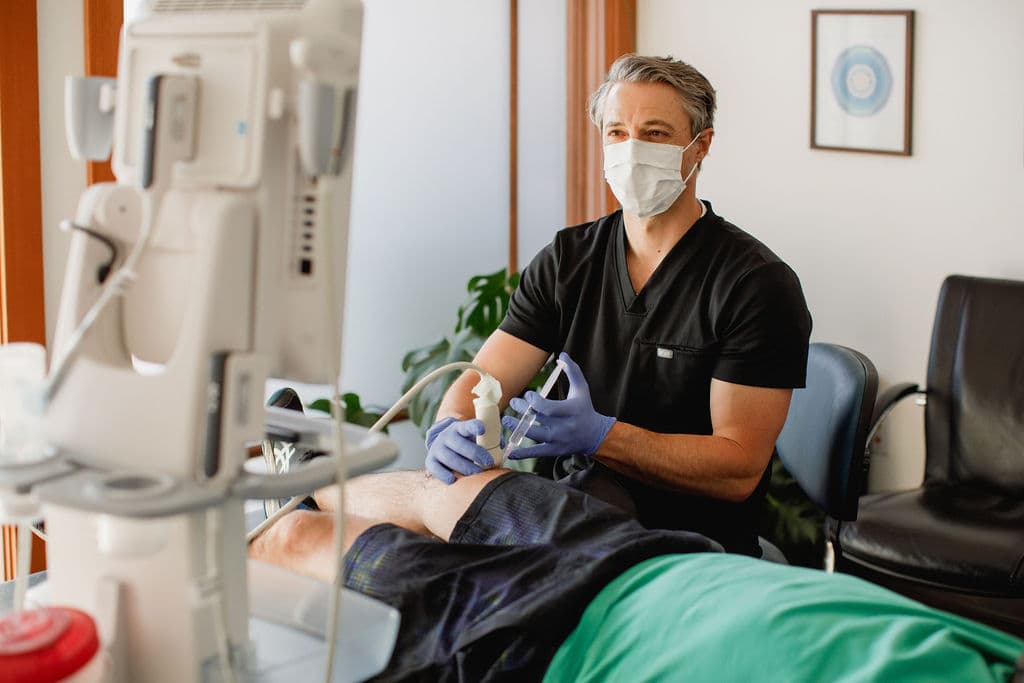
Ultrasound assessment of the knee at Dr. Borys's clinic in Bellingham, WA
Back to Conditions
Knee pain

Knee pain treatment in Bellingham, WA

Knee pain can come from worn cartilage, an overloaded tendon, or a frayed meniscus, and each is treated differently. Dr. Borys uses a hands-on exam and, when useful, in-office ultrasound to identify the likely source before recommending treatment.

Book an initial visit
Common patterns

Does one of these sound like yours?

Where the pain sits and what sets it off are useful early clues. These patterns often overlap, and the exam sorts them out.

Knee osteoarthritis

Gradual wear of the joint cartilage, and the most common cause of ongoing knee pain after middle age.

Where it hurts
Inside of the knee or across the whole joint, with a deep ache
What makes it worse
Stiff after sitting or first thing in the morning; worse with stairs, squatting, and long walks
How it starts
Gradual over months to years, often with flares after more activity
Telltale clue
Stiffness that eases after a few minutes of moving; sometimes swelling or grinding

Treatment approach: Exercise and weight management first; PRP has strong evidence for mild to moderate arthritis

Knee osteoarthritis treatment
Patellar tendinopathy

An overloaded tendon just below the kneecap, common in people who jump, run, or squat under load.

Where it hurts
A specific spot at the bottom of the kneecap you can press on
What makes it worse
Hurts with jumping, squatting, and stairs; often eases once warmed up, then aches afterward
How it starts
Gradual, usually after a jump in training volume or a new sport
Telltale clue
Pain stays at that one spot rather than spreading across the joint

Treatment approach: Progressive tendon loading first; shockwave and PRP are options when loading alone stalls

Patellar tendinopathy treatment

Degenerative meniscus tear

Age-related fraying of the knee cartilage pad, frequently alongside early arthritis.

Where it hurts
Along the joint line on the inside or outside of the knee
What makes it worse
Pain with twisting, pivoting, or deep squatting; sometimes a catching sensation
How it starts
Gradual or after a minor twist, usually in adults over 40
Telltale clue
Often shows up on MRI in people with no pain at all, so the exam matters more than the scan

Treatment approach: Exercise therapy first; trials show surgery is rarely needed for degenerative tears

Read: do you need surgery?
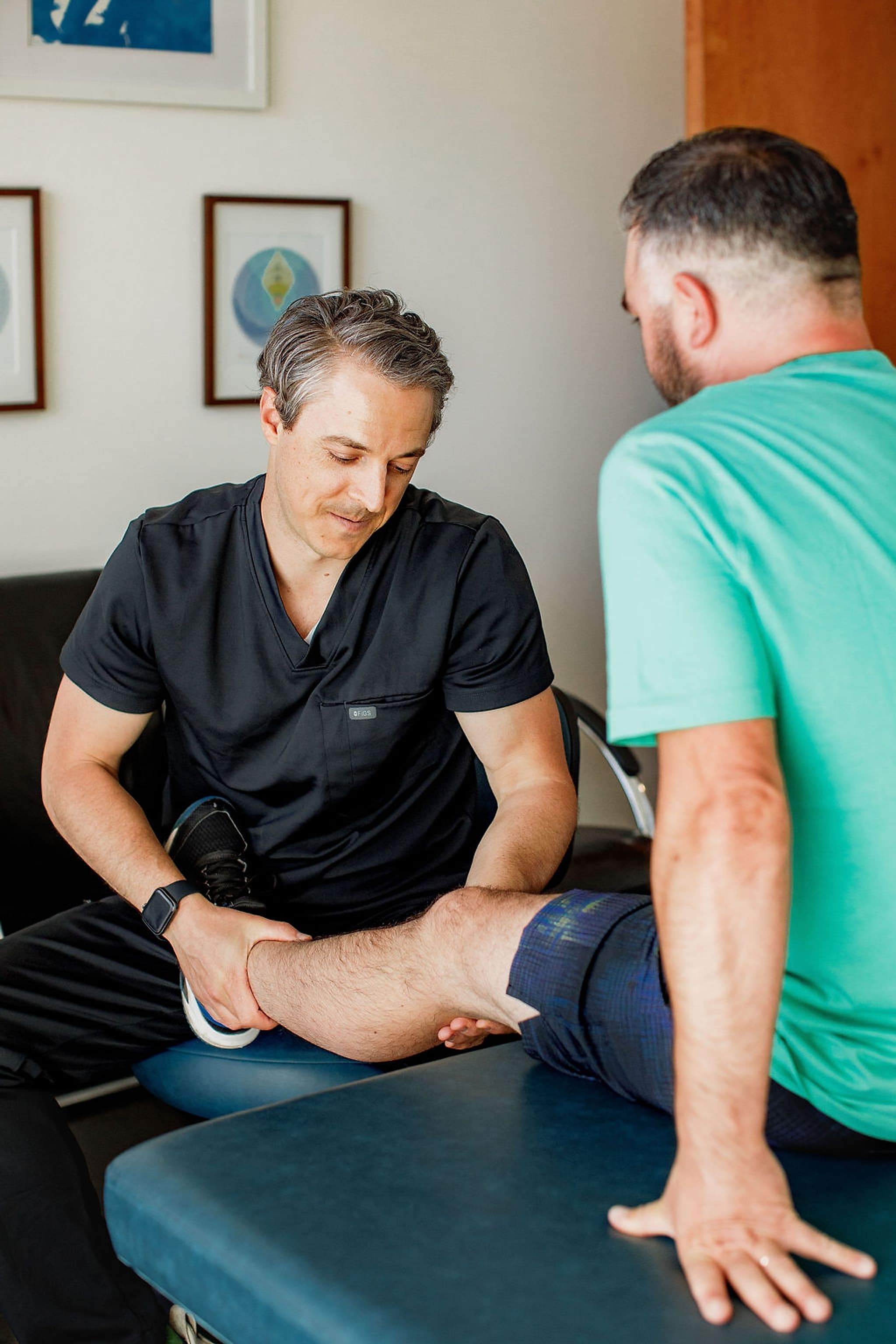
Dr. Borys examining a patient during an initial visit
How the evaluation works

Exam first, imaging when it helps

Your first visit includes a full knee exam. When imaging would clarify the picture, diagnostic ultrasound can be done in the same appointment. It shows the patellar tendon, fluid in the joint, bursitis, and a Baker's cyst while you move.

Ultrasound does not show cartilage inside the joint well. A standing X-ray is the usual test for arthritis, and MRI is better for ligament injuries or a knee that locks. When the findings point that way, Dr. Borys orders the right test or refers for an orthopedic opinion.

Many patients arrive with an earlier X-ray or MRI. Bring the report, and the images if you have them.

Other knee conditions

Not one of the three above?

These conditions are also assessed at the initial visit. The next step depends on the exam findings, and sometimes that step is imaging or a referral.

  • Patellofemoral pain

    Ache around or behind the kneecap with stairs, squatting, or sitting with bent knees. Usually managed with strengthening and load changes.

  • Pes anserine bursitis

    Tenderness on the inner shin just below the knee, often alongside knee arthritis.

  • IT band syndrome

    Pain on the outside of the knee that builds during runs or long downhill walks.

  • Ligament sprains

    Pain on the inner or outer knee after a twist or a blow. Most heal with protected loading and rehab.

  • Acute injuries with instability

    A pop, rapid swelling, or the knee giving way can mean an ACL or other structural injury. These are referred for imaging and an orthopedic opinion.

  • Baker's cyst

    Fullness or tightness behind the knee, usually caused by an underlying joint problem such as arthritis. Ultrasound shows it clearly.

Frequently Asked Questions

Knee Pain: Common Questions

What is the most common cause of knee pain?

In adults over 50, knee osteoarthritis is the most common cause of ongoing knee pain. In younger, active people, patellar tendinopathy and pain around the kneecap are more common.

Degenerative meniscus tears often appear alongside early arthritis. Each condition is treated differently, so identifying the source comes before choosing a treatment.

Do I need an MRI for knee pain?

Often not. A hands-on exam, and a standing X-ray when arthritis is suspected, answer most questions.

MRI is the better test after an injury with instability or when the knee locks. Degenerative meniscus tears show up on MRI in many people without pain, so a scan alone rarely decides treatment.

Does knee pain usually need surgery?

Most knee pain from arthritis, tendinopathy, or a degenerative meniscus tear improves with non-surgical care. Randomized trials show arthroscopic surgery offers little lasting benefit over exercise therapy for degenerative meniscus tears.

An acute injury with a pop, rapid swelling, or the knee giving way, or a knee that locks and cannot straighten, warrants prompt imaging and an orthopedic opinion. Dr. Borys refers when the findings call for it.

Is knee pain treatment covered by insurance in Bellingham?

The initial evaluation is a standard office visit and may be billable to insurance depending on your plan. PRP, prolotherapy, and shockwave therapy are generally not covered and are paid out of pocket.

Bellingham, WA

Find out what is causing your knee pain

Dr. Borys sees knee patients at his Bellingham clinic, serving Whatcom County, Skagit County, and the San Juan Islands.

The information on this page is for general educational purposes only and is not individual medical advice. It is not a substitute for a consultation with a qualified provider. Whether a treatment is appropriate depends on your individual evaluation, and individual results vary.