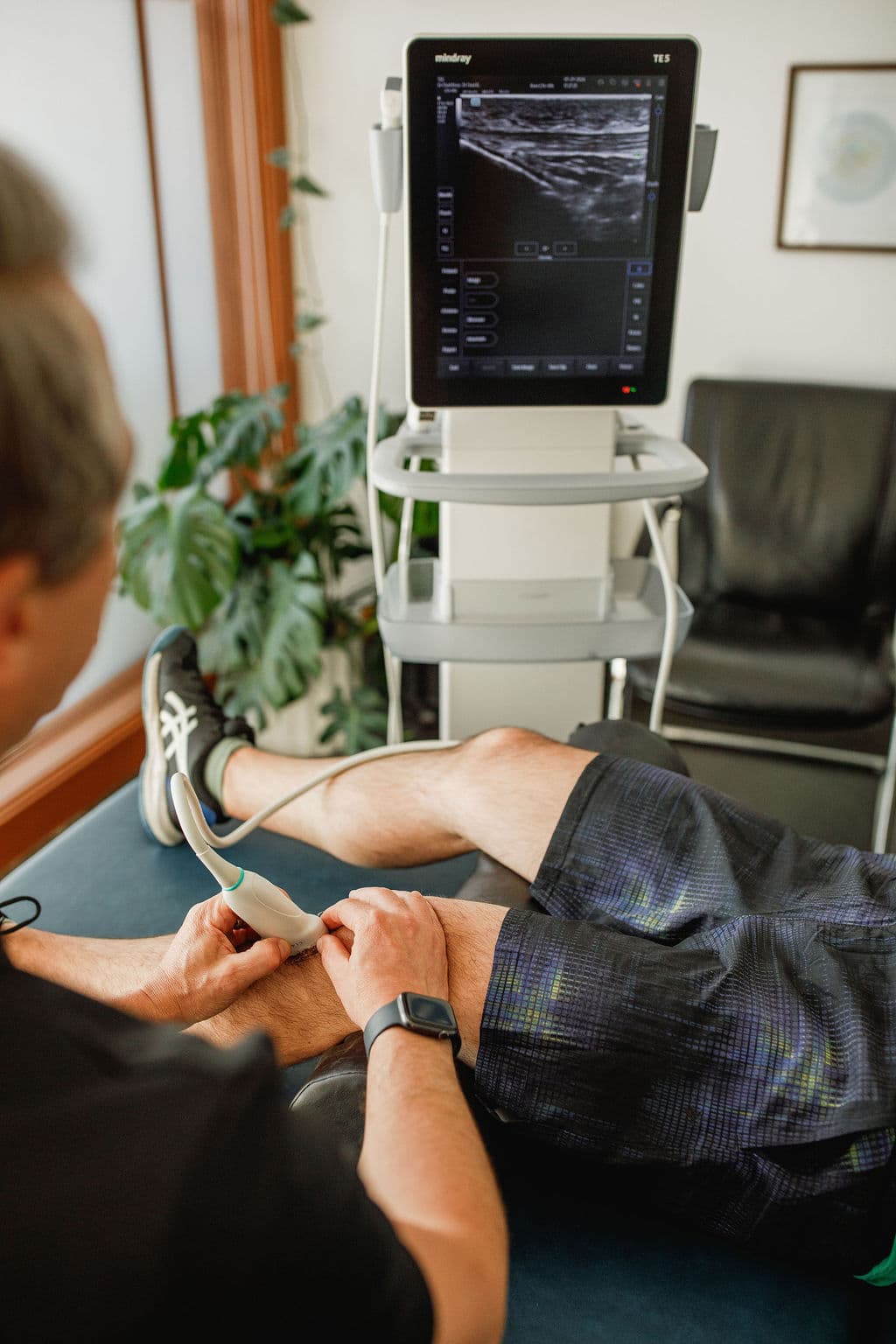
Carpal tunnel syndrome treatment in Bellingham, WA
Waking up with numb hands, dropping objects, or losing grip strength — carpal tunnel syndrome compresses the median nerve at the wrist. Dr. Borys offers ultrasound-guided nerve hydrodissection as a non-surgical option supported by multiple randomized trials.
Book an initial visitMedian nerve compression at the wrist
The carpal tunnel is a narrow channel at the base of the wrist formed by the carpal bones and the transverse carpal ligament. The median nerve passes through this tunnel alongside the flexor tendons of the hand. When pressure inside the tunnel increases — from tendon swelling, repetitive loading, fluid retention, or anatomical factors — the median nerve becomes compressed and begins to signal abnormally.
The result is the characteristic symptom pattern: numbness and tingling in the thumb, index, middle, and part of the ring finger; symptoms that are worse at night or with sustained wrist positions; and, in more advanced cases, weakness and wasting of the thenar muscles at the base of the thumb.
Carpal tunnel syndrome is the most common peripheral nerve entrapment. It is more prevalent in women, in people over 40, in those with diabetes or thyroid disorders, and in occupations involving sustained wrist flexion or repetitive hand use.
Ultrasound-guided dextrose hydrodissection for carpal tunnel syndrome has support from multiple randomized controlled trials. Studies show meaningful improvements in symptom severity, hand function, and grip strength at 6 and 12 months. A 2023 systematic review and meta-analysis confirmed efficacy for ultrasound-guided perineural injection. There is also RCT evidence supporting hydrodissection in patients with persistent symptoms after surgical release.
Why patients consider this
- Numbness and tingling that wakes you at night or persists through the day
- Grip weakness making it difficult to open jars, hold a phone, or type for extended periods
- Had a cortisone injection that helped temporarily but symptoms have returned, or have not responded to conservative care at all
- Want to know exactly what is happening at the wrist before any treatment is offered
How Dr. Borys approaches carpal tunnel syndrome
Treatment is hydrodissection-led. Perineural injection therapy is used as an adjunct when nerve-driven pain extends beyond the carpal tunnel distribution.
Nerve Hydrodissection
Primary approachUltrasound-guided injection of a buffered 5% dextrose solution around the median nerve at the carpal tunnel separates the nerve from surrounding tissue planes and reduces mechanical compression. Multiple randomized controlled trials show dextrose hydrodissection produces meaningful improvements in symptom severity, hand function, and nerve conduction — with effects sustained at 6 and 12 months.
Learn more about nerve hydrodissectionPerineural Injection Therapy
Small amounts of low-concentration dextrose injected at intervals along the median nerve to settle nerve-driven aching or burning that extends up the forearm beyond the typical carpal tunnel distribution. Used as an adjunct to hydrodissection when proximal symptoms are present.
Learn more about perineural injection therapyWhat the randomized trial evidence shows
The evidence base for dextrose hydrodissection in carpal tunnel syndrome includes multiple randomized controlled trials, which is uncommon for injection-based treatments. The key trials are summarized below.
Ultrasound-Guided Perineural Injection Effective for Carpal Tunnel Syndrome
Systematic review and meta-analysis (Lam et al., Diagnostics 2023) evaluated ultrasound-guided perineural injection for CTS across multiple trials. Dextrose hydrodissection produced significant improvements in symptom severity and hand function scores, with effects maintained at follow-up. The review identified injection volume as a meaningful variable — higher volumes associated with greater mechanical separation of the nerve.
PubMed 36980446Injection Volume Matters: Higher-Volume Dextrose Produces Superior Results
Randomized double-blinded three-arm trial (Lin et al., Front Pharmacol 2020, n=63 wrists) compared 1 ml, 2 ml, and 4 ml of 5% dextrose for CTS. The 4 ml arm produced superior reductions in Boston Carpal Tunnel Questionnaire symptom severity and functional status scores at weeks 1, 4, and 12. Results support higher injection volume as a meaningful technical variable in nerve hydrodissection.
PubMed 33391002Dextrose Hydrodissection Outperforms Corticosteroid at Six Months
Prospective randomized double-blind placebo-controlled trial (Wu et al., Mayo Clin Proc 2017, n=60) compared 5% dextrose perineural injection to normal saline for mild-to-moderate carpal tunnel syndrome. At all follow-up points through 6 months, the dextrose group showed significantly greater improvement in pain, symptom severity, functional status, nerve conduction velocity, and median nerve cross-sectional area. The first high-quality placebo-controlled RCT to demonstrate dextrose superior to saline for CTS.
PubMed 28778254Dextrose vs Corticosteroid: Randomized Double-Blind Trial with Neural Imaging
Randomized double-blind trial (Wu et al., Ann Neurol 2018, n=80) compared 5% dextrose and triamcinolone hydrodissection with neural ultrasound outcome measures. The dextrose group showed significantly greater reduction in median nerve cross-sectional area at the wrist — a direct measure of nerve decompression — alongside greater improvements in symptom severity and functional scores at 6 months.
PubMed 30187524Hydrodissection Effective for Persistent Symptoms After Carpal Tunnel Surgery
Retrospective study (Chao et al., J Clin Med 2022) evaluated dextrose hydrodissection in patients with persistent or recurrent CTS after primary surgical release — a population with limited treatment options. Hydrodissection produced significant improvements in symptom severity and functional scores, suggesting value as a non-surgical option even after failed surgery.
PubMed 35806998Who tends to benefit — and who does not
Hydrodissection tends to be a reasonable option for people who:
- Have confirmed or clinically suspected carpal tunnel syndrome based on symptoms and exam
- Have persistent numbness, tingling, or weakness that has not resolved with splinting or a cortisone injection
- Want a non-surgical option before committing to open or endoscopic carpal tunnel release
- Have had carpal tunnel surgery but continue to have symptoms — limited clinical evidence suggests hydrodissection may help in selected cases
It is less likely to be the right starting point for people who:
- Have early or mild symptoms that may still respond to consistent splinting and activity modification alone
- Have severe thenar muscle wasting suggesting advanced axonal loss — surgical release is generally the better option at that stage
- Have a different diagnosis causing hand symptoms — cervical radiculopathy, thoracic outlet, and pronator syndrome can mimic CTS closely, and examination will clarify this
Whether hydrodissection is appropriate depends on the duration and severity of your symptoms, prior treatment history, and findings on exam and ultrasound. Dr. Borys will review all of this at the initial visit.
Ready for a closer look at what may be driving your pain?
You are not signing up for a procedure. The first visit is a medical evaluation: history, exam, imaging review when relevant, and a clear recommendation — whether that is regenerative care, rehab, referral, or watchful waiting.
Carpal Tunnel Syndrome Treatment: Common Questions
How is hydrodissection different from a cortisone injection for carpal tunnel?
A cortisone injection reduces inflammation inside the carpal tunnel and often provides useful short-term relief — typically 1 to 3 months. It does not physically separate the nerve from compressed tissue. Hydrodissection uses fluid pressure to mechanically separate the median nerve from surrounding structures, with the goal of reducing ongoing compression rather than suppressing inflammation. For symptoms that have returned after cortisone, hydrodissection is a reasonable next step.
Is hydrodissection an alternative to carpal tunnel surgery?
For many patients with mild-to-moderate carpal tunnel syndrome, yes — hydrodissection offers a non-surgical option with RCT support. There is also limited clinical evidence suggesting benefit in selected patients with persistent symptoms after surgical release. For severe CTS with significant thenar muscle wasting or advanced axonal loss on nerve conduction study, surgical release is generally the more appropriate intervention and Dr. Borys will say so clearly at the visit.
How many injections are typically needed?
Response varies by severity and duration of compression. Some patients experience significant improvement after a single session. Others benefit from two or three sessions spaced several weeks apart. The number of sessions will depend on your response and will be discussed after the initial evaluation.
Does Dr. Borys use ultrasound for the injection?
Yes. Ultrasound guidance is essential for nerve hydrodissection — it allows Dr. Borys to visualize the median nerve in real time, confirm the site of compression, and guide accurate placement of fluid around the nerve rather than into it. Blind injection into the carpal tunnel carries a risk of nerve contact that ultrasound guidance avoids.
My nerve conduction study was normal but my symptoms are consistent with carpal tunnel. Can hydrodissection still help?
Nerve conduction studies can be normal in early or mild carpal tunnel syndrome. Clinical diagnosis — based on symptom pattern, physical examination, and ultrasound assessment of median nerve cross-sectional area — can support a carpal tunnel diagnosis even when electrodiagnostics are equivocal. Dr. Borys will review your history, exam findings, and any available studies before recommending treatment.
The information on this page is for general educational purposes only and is not individual medical advice. It is not a substitute for a consultation with a qualified provider. Whether a treatment is appropriate depends on your individual evaluation, and individual results vary.