Frozen Shoulder Treatment in Bellingham, WA
Frozen shoulder often improves over time, but recovery can take many months to several years, and some people are left with persistent stiffness. Dr. Borys evaluates the severity and pattern of motion loss, rules out other shoulder problems, and helps you compare the full range of treatment options — including physical therapy, corticosteroid injection, hydrodilatation, PRP, shockwave therapy, or referral when appropriate.
Book an initial visitA capsular problem that moves through three stages
Frozen shoulder — formally adhesive capsulitis — is a condition in which the fibrous capsule surrounding the glenohumeral joint thickens, contracts, and restricts motion in all directions. Unlike rotator cuff problems, which tend to affect specific movements, frozen shoulder reduces the entire range: overhead, behind the back, and external rotation all become painful and limited.
It occurs more often in women, in people over 40, and in those with diabetes or thyroid conditions. It frequently follows shoulder immobility after surgery or injury. In many cases no clear precipitant is identified.
Many people improve over time, but the course is not reliably predictable and full recovery is not assured. Treatment is matched to the stage and irritability of the shoulder, not to a single preferred procedure.
Freezing phase
3–9 monthsGradual onset of shoulder pain, worse at night. Motion begins to decrease. Pain is often the dominant feature and the main driver of treatment decisions.
Frozen phase
4–12 monthsPain may plateau or improve slightly but stiffness is now severe. Daily activities — dressing, reaching, sleeping on the affected side — are significantly restricted.
Thawing phase
5–24 monthsMotion slowly returns. Pain continues to improve. This phase can take one to two years, and some patients do not fully recover their pre-illness range of motion.
Total duration commonly ranges from 1 to 3 years, and some patients are left with long-term restriction. Treatment aims to reduce pain, preserve function, and potentially accelerate recovery — not guarantee full resolution.
How frozen shoulder is managed
Management follows a stepwise approach based on stage and how the shoulder is responding. Dr. Borys discusses the full range of options at the initial visit — the appropriate step depends on where you are in the condition and what has already been tried.
Education and pain management
Understanding the staged natural history and setting realistic expectations is the foundation of management. Analgesics, anti-inflammatories, and activity modification are addressed first.
Physical therapy and mobility work
Pendulum exercises, passive stretching, and — in the frozen and thawing phases — progressive manual therapy and range-of-motion work. The appropriate intensity depends on the stage and irritability of the shoulder.
Corticosteroid injection
Intra-articular corticosteroid is well-supported for short-term pain relief, particularly during the freezing phase. It is one of the most studied interventions for adhesive capsulitis and is a reasonable early option.
Hydrodilatation
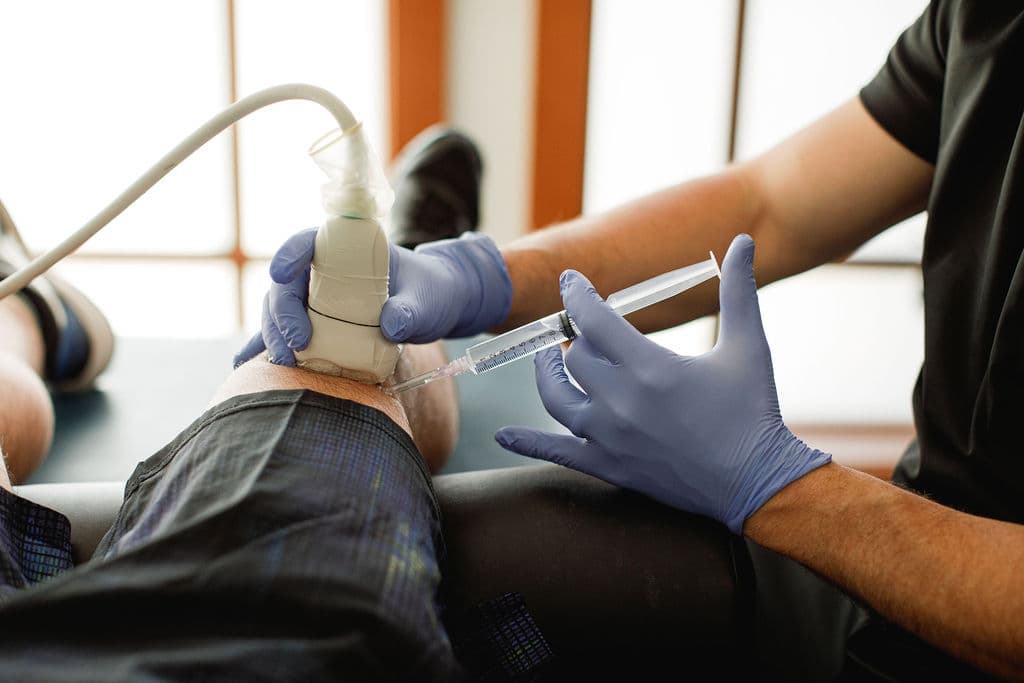
Ultrasound-guided injection of saline (with or without corticosteroid) to distend the joint capsule. Evidence supports improvement in pain and range of motion, and it is an option when standard corticosteroid injection has not provided adequate relief.
PRP, shockwave, and perineural injection
Regenerative and neurogenic options with trial support. PRP shows better intermediate-term outcomes than corticosteroid at 3 and 6 months in meta-analysis data. Shockwave has randomized-trial support as an adjunct to exercise and mobility work — it may improve pain and function, though overall certainty of evidence remains limited. Perineural injection addresses the neurogenic pain component when sensitization is a feature.
Surgical options
Manipulation under anesthesia and arthroscopic capsular release are reserved for refractory cases — typically after 6–12 months of appropriate non-surgical management without adequate progress.
What Dr. Borys offers within that pathway
These are not replacements for the standard management pathway — they are evidence-supported options that sit alongside it, used selectively based on stage, prior treatment history, and patient preference.
PRP Injection
Concentrated platelets and growth factors from your own blood injected into the glenohumeral joint under ultrasound guidance. Meta-analysis data show PRP provides comparable short-term relief to corticosteroid but significantly better outcomes at 3 and 6 months. A reasonable option when corticosteroid has provided insufficient or short-lived improvement, or when avoiding repeated steroid is a priority.
Learn more about PRP therapyShockwave Therapy
Shockwave has randomized-trial and meta-analysis support as an adjunct to exercise and mobility work for adhesive capsulitis. It may improve pain and function, although protocols vary and the overall certainty of evidence remains limited. Particularly well-suited for patients who prefer to avoid injection, or as a complement to manual therapy and stretching.
Learn more about shockwave therapyPerineural Injection Therapy
Low-concentration dextrose injected around the superficial nerves supplying the shoulder capsule to quiet sensitized pain signaling. Most useful when the painful freezing phase is driven significantly by neurogenic sensitization, and as a complement to other treatments rather than a standalone approach.
Learn more about perineural injection therapyWho tends to benefit most from this visit
A reasonable fit if you…
- Have been diagnosed with adhesive capsulitis or have significant, progressive loss of shoulder motion
- Have completed a trial of physical therapy and are not progressing as expected
- Have had one or more corticosteroid injections without lasting improvement
- Want to discuss the full range of options — including PRP, shockwave, hydrodilatation, and nerve block — at a single visit
- Are looking for a treatment plan matched to the stage and irritability of your shoulder, not a single default procedure
May not be the right fit if you…
- Have early-stage stiffness that may still respond to consistent stretching and physical therapy alone
- Have a different diagnosis causing shoulder stiffness — examination and ultrasound will clarify this before any treatment is offered
- Have an active infection, certain blood or platelet disorders, or active cancer (relevant to injection options)
- Need a guaranteed outcome — frozen shoulder is a condition that takes time regardless of treatment
What the research shows for PRP and shockwave
PRP Outperforms Corticosteroid at 3 and 6 Months
A 2026 meta-analysis of 7 randomized trials (692 participants) found PRP and corticosteroid comparable at one month — but at three and six months, PRP produced significantly better pain relief, shoulder range of motion, and functional scores.
View on PubMed →PRP vs Hyaluronic Acid vs Corticosteroid for Adhesive Capsulitis
A 2025 meta-analysis of six studies (Valencia et al.) found that PRP and hyaluronic acid may provide more durable pain and functional improvement than corticosteroid at six months. Three-month differences were less consistent, and substantial variation among the included studies limits certainty about the size of the benefit.
View on PubMed →Radial ESWT Combined with Physical Therapy Outperforms Sham
Randomized controlled trial (Sharahili et al., 2025) found radial shockwave combined with evidence-based physical therapy produced significantly greater reductions in pain and disability than sham plus physical therapy at 12 weeks, with meaningful improvements in shoulder flexion, abduction, and external rotation.
View on PubMed →PRP Outperforms Corticosteroid and Physical Therapy at 3 and 6 Months
Systematic review of 11 studies (971 patients) found PRP outperformed both corticosteroid injection and physical therapy on pain, function, and range of motion at three and six months. The advantage over corticosteroid grew larger at the six-month mark.
View on PubMed →For a deeper look at the trial data: Read the full review of PRP research for frozen shoulder
Frozen shoulder evaluation and treatment in Bellingham
Dr. Borys sees patients with adhesive capsulitis from Bellingham, Ferndale, Lynden, Anacortes, and the broader Whatcom and Skagit County area. The initial visit includes a history and physical examination to establish the clinical diagnosis. Ultrasound is used to assess the rotator cuff, biceps tendon, joint, and other conditions that may mimic or accompany frozen shoulder.
From there, a treatment plan is built around what the shoulder needs — not a default procedure. If the most appropriate next step is a referral to a physical therapist, orthopedic surgeon, or another provider, that recommendation will be made directly.
What the initial visit covers
- Full shoulder history — onset, prior treatment, current phase
- Physical examination to confirm global motion loss vs. selective restriction
- Diagnostic ultrasound to assess the rotator cuff, biceps tendon, and rule out other shoulder conditions
- Stage and irritability assessment to guide treatment sequencing
- Discussion of the full range of options — including injection, shockwave, hydrodilatation, and surgical referral criteria
Frozen Shoulder Treatment: Common Questions
How is frozen shoulder different from a rotator cuff problem?
Frozen shoulder (adhesive capsulitis) is a contracture of the joint capsule itself — the fibrous lining around the shoulder joint thickens and tightens, restricting motion in all directions. Rotator cuff problems primarily involve the tendons and typically cause pain with specific movements rather than global loss of motion. The distinction matters because the treatment approach differs significantly, and the two can co-exist. Examination and ultrasound distinguish them at the initial visit.
Does cortisone work for frozen shoulder?
Corticosteroid injection is well-supported for short-term pain relief in adhesive capsulitis — particularly during the painful freezing phase — and is one of the most studied interventions for this condition. The evidence shows it works well in the short term. However, the advantage over PRP diminishes at 3 and 6 months in systematic review data, and repeated injections carry risks for surrounding tissue. It is a reasonable early option, and for many patients it is the right first injection.
Is PRP better than cortisone for frozen shoulder?
In the short term — the first month — PRP and corticosteroid produce comparable results. At three and six months, meta-analysis data show PRP produces significantly better pain relief, range of motion, and functional outcomes. PRP is a reasonable option when cortisone has provided insufficient or short-lived improvement, or when avoiding repeated steroid is a priority. It is not necessarily the first step for everyone.
Can frozen shoulder resolve on its own?
Yes — adhesive capsulitis is generally self-limiting, meaning it tends to resolve over 1 to 3 years without intervention. However, many patients do not fully recover their pre-illness range of motion, and the freezing phase can be significantly painful for months. Treatment aims to reduce pain, support function, and shorten the overall course — not guarantee full resolution.
Does Dr. Borys use ultrasound for injections?
Yes. Ultrasound guidance allows accurate placement into the glenohumeral joint rather than relying on surface landmarks. This improves precision and is standard practice for shoulder injections in this clinic.
Ready to get a clear picture of what is happening?
The initial visit establishes the diagnosis, stages the shoulder, reviews what has been tried, and maps out the options that make sense for where you are now.
Related conditions
Rotator cuff tendinopathy
Shoulder tendon pain that often precedes or accompanies adhesive capsulitis — ultrasound helps assess the cuff and rule out significant tearing.
Calcific tendinitis
Calcium deposits in the rotator cuff cause a distinct shoulder pain pattern — sometimes confused with frozen shoulder but treated very differently.
Perineural injection therapy
Used alongside other treatments when a neurogenic pain component is present in the freezing phase.
The information on this page is for general educational purposes only and is not individual medical advice. It is not a substitute for a consultation with a qualified provider. Whether a treatment is appropriate depends on your individual evaluation, and individual results vary.