PRP for Golfer's Elbow in Bellingham, WA
When gripping, lifting, or a simple handshake sends pain through the inside of your elbow — and a strap and rest haven't fixed it — the tendon itself is the problem. PRP targets that tissue directly, not just the pain.
Book an initial visitCan PRP help golfer's elbow?
Bottom line
For chronic golfer's elbow that hasn't improved with rest, bracing, and physical therapy, PRP is a well-studied non-surgical option. For recalcitrant cases, randomized trials (Bohlen, Alzahrani) have demonstrated PRP outcomes equivalent to surgical release — with an earlier return to full motion and pain-free use. It works gradually, targeting the flexor tendon itself, and helps most in long-standing cases rather than a brand-new strain.
Golfer's elbow (medial epicondylitis) develops when the common flexor tendon on the inner elbow becomes overloaded and degenerates, leading to pain with gripping, lifting, and bending the wrist. Despite the name, most cases have nothing to do with golf — they come from repetitive gripping and forearm use at work, in the gym, or around the house.
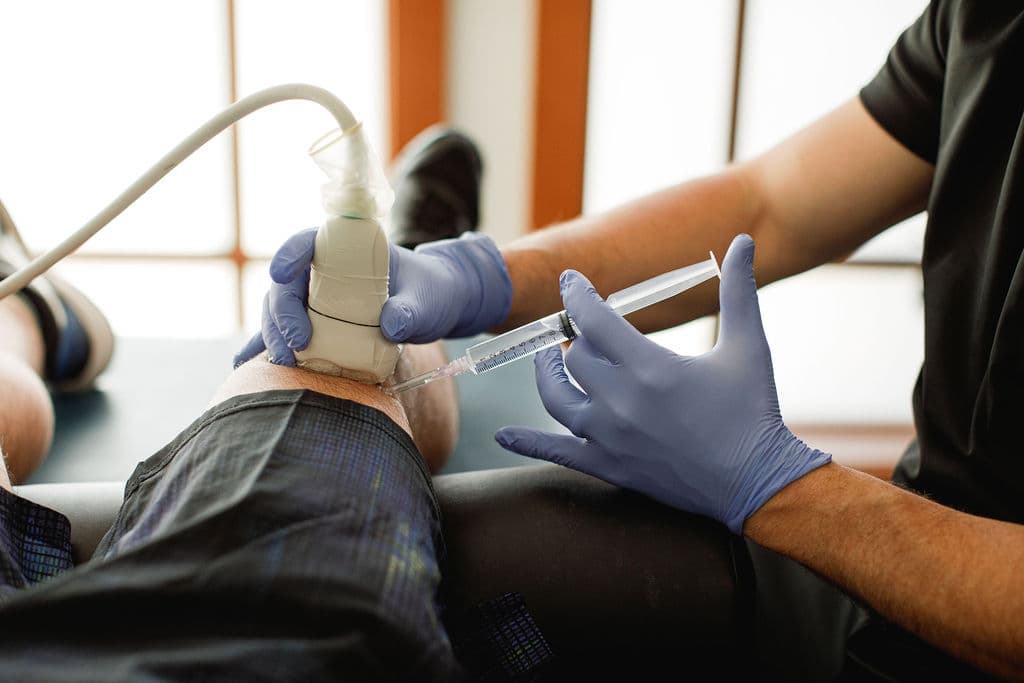
Platelet-Rich Plasma (PRP) therapy concentrates the platelets and growth factors from a small sample of your own blood and delivers them directly into the injured flexor tendon under ultrasound guidance. The goal is to support a local repair response in chronically irritated tendon tissue.
PRP works best in chronic medial elbow pain that has persisted beyond conservative care — not every case warrants it. Whether it is a reasonable option depends on the duration, severity, and findings on exam.
Medial tendons in a long-term degenerative state often don't self-resolve, and repeated cortisone shots are linked to tissue weakening over time. For elbows that have already failed months of conservative care, earlier intervention means a shorter overall recovery.
Why patients consider PRP for golfer's elbow
Golfer's elbow is harder to treat than its lateral counterpart. PRP gives the flexor tendon a direct biological signal to repair — something neither rest nor cortisone delivers.
Grip a wrench, golf club, or steering wheel without stopping because of inner-elbow pain
Get back to the work, hobby, or sport that has been on hold for months
Stop cycling through cortisone shots that help for a few weeks and then wear off
Address the flexor tendon itself — not just the pain on top of it
For persistent cases: smaller comparative studies suggest PRP may be a reasonable option to consider before surgical release
An outpatient option that uses your own biology with no incision and no general anesthesia
Where PRP fits: conservative care comes first
PRP is not the first thing to try for golfer's elbow. For most people, a structured, non-invasive plan should come first — and many elbows improve without any injection. PRP is best considered when those steps haven't worked.
PRP is for the elbow that has already done the work
Load management and a structured wrist-flexor strengthening program are the right first steps — and many golfer's elbows improve without any injection. PRP earns its place in the stubborn case: when months of consistent conservative care haven't resolved the pain. Randomized trials have shown PRP outcomes equivalent to surgical release for recalcitrant medial epicondylitis — making it a compelling option to try before surgery. If your inner elbow is still limiting you after several months of rehab, it's worth finding out what the exam shows.
What to expect after a golfer's elbow PRP injection
PRP for golfer's elbow is measured in months, not days. Knowing what each phase looks like prevents abandoning the treatment before it has had time to work.
Inner elbow soreness
Increased aching at the medial epicondyle for up to a week is expected — the injection triggers an acute inflammatory response in the flexor tendon. Reduce activity to keep discomfort manageable; strict rest is not required.
Activity as tolerated: if pain is above a 2 out of 10, ease back. Avoid NSAIDs — acetaminophen is fine if needed.
The quiet phase
Initial soreness subsides and most patients return to close to baseline activity, but clear improvement has typically not arrived yet. The tendon is remodeling — feeling no better than before the injection is normal at this stage.
Premature return to gripping-intensive work or sport during this window is the most common reason recovery stalls.
Early improvement
Pain with gripping, lifting, and forearm rotation begins to ease. A gradual return to sport or work activities is usually appropriate in this window, following Dr. Borys's specific guidance.
Full response
Tendon effects take 3–4 months to be fully appreciated. The medial epicondylitis RCTs (Bohlen, Alzahrani) measured outcomes at 6 and 12 months. Dr. Borys reassesses at 3 months to confirm the tendon is responding.
Golfer's elbow typically requires a single injection for appropriate candidates — the goal is durable recovery, not repeated procedures.
Supporting your recovery
Some elbow soreness is normal
Mild soreness or aching at the inner elbow for a few days is expected and is part of the healing response as the tendon responds to treatment.
Ease back into activity
Most patients rest the arm for a few days, then gradually return to normal use and any prescribed rehab following Dr. Borys’s specific guidance.
Avoid anti-inflammatories
Unless directed otherwise, avoid NSAIDs (such as ibuprofen) around the procedure, since they can blunt the healing response PRP is meant to support.
Improvement takes time
PRP for the elbow works gradually. Many patients notice clearer improvement around 4–8 weeks, with continued change over several months as the tendon heals.
Is golfer's elbow PRP right for you?
The medial elbow is less studied than the lateral side, but the evidence that exists is positive — and for persistent cases, smaller comparative studies suggest PRP may be a reasonable option to consider before surgical release in selected patients. A consultation and exam determine whether it is the right move for your elbow.
Golfer's elbow PRP may be a good fit if you
- Have chronic golfer's elbow (medial epicondylitis) that has lasted months
- Have not had lasting relief from rest, bracing, physical therapy, or other conservative care
- Want a non-surgical option that uses your own biological material
- Can allow several weeks to months for a gradual response
Less likely to be appropriate if you
- Have a brand-new strain that may still respond to rest and rehab
- Need immediate or guaranteed pain relief
- Have an active infection, certain blood or platelet disorders, or active cancer
- Cannot pause anti-inflammatory medications when advised
This list is a general guide, not medical advice. Dr. Borys will review your history, exam, and goals to recommend the most appropriate option for your elbow.
If that describes your inner elbow, it's worth finding out more.
An initial evaluation covers your history, exam, and the options that actually make sense for where you are.
The research on PRP for golfer's elbow
The evidence base for medial epicondylitis is smaller than for tennis elbow, but it points in a favorable direction. For persistent medial epicondylitis, smaller comparative studies suggest PRP may be a reasonable option to consider before surgical release in selected patients— a lower-risk path worth exploring before committing to an operation.
PRP Equal to Surgery for Recalcitrant Cases
Comparative study (Bohlen et al., Orthopaedic Journal of Sports Medicine, 2020) found that for recalcitrant type 1 medial epicondylitis, PRP produced clinically similar outcomes to surgery — with an earlier return to full range of motion and pain-free status.
Read on PubMedPRP comparable to surgery in systematic review
Systematic review (Alzahrani et al., Cureus, 2022) found PRP comparable to surgery in relieving pain and restoring function for medial epicondylitis, particularly in the short and mid-term — a finding the authors note warrants larger confirmatory trials.
Read on PubMedPRP Effective for the Inner Elbow
Clinical outcomes study (Park et al., Orthopaedic Surgery, 2023) found that PRP injection effectively reduced pain in patients with medial epicondylitis, including when lateral and medial epicondylitis were treated at the same time.
Read on PubMedWhere Injections Fit in Management
Review of medial epicondylitis management (Tahir et al., Cureus, 2026) describing a stepped approach — rehabilitation first, targeted injections when symptoms persist, and surgery reserved for chronic, treatment-resistant disease.
Read on PubMedWhat the evidence does — and doesn't — show
Medial epicondylitis is less studied than tennis elbow, and PRP preparations differ between studies, so the research isn't perfectly uniform. The most consistent signal is that for chronic, stubborn cases, PRP performs comparably to surgical release — relieving pain and restoring function without an operation.
The practical takeaway: PRP is not a guaranteed cure, and most golfer's elbows should start with load management and rehab. But when those haven't worked, a well-prepared injection placed accurately under ultrasound guidance delivers a well-documented healing response — and a reasonable next step before surgery becomes a serious consideration.
PRP vs. Cortisone for Golfer's Elbow
Patients often ask whether they should just get a cortisone shot for golfer's elbow. It's a fair question — and the honest answer comes down to short-term relief versus long-term healing.
What a cortisone shot does
A corticosteroid injection is anti-inflammatory and can ease inner-elbow pain quickly — often within days. The trade-off is that the relief is usually short-lived, recurrence is common, and repeated steroid injections may weaken the flexor tendon over time rather than help it heal.
How they compare over time
Cortisone tends to win in the first few weeks, but its benefit fades and the problem often returns. PRP works more slowly and aims to heal the tendon itself — and for persistent medial epicondylitis, smaller comparative studies suggest PRP may be a reasonable option to consider before surgical release.
Golfer's elbow treatment — Bellingham, WA
Based in Bellingham, Dr. Borys sees patients from Whatcom County, Skagit County, the San Juan Islands, and surrounding Northwest Washington communities.
Related conditions
Tennis elbow
Lateral elbow tendinopathy — mirror presentation on the outer side, same evidence base for PRP.
Rotator cuff tendinopathy
Shoulder tendon pain often presenting alongside chronic upper-limb tendinopathies.
PRP therapy
Learn how platelet-rich plasma works, what the preparation involves, and which conditions have the strongest evidence.
Shockwave therapy
Non-invasive acoustic-wave treatment often used alongside PRP for stubborn elbow tendinopathy.
PRP for Golfer's Elbow: Common Questions
Does PRP actually work for golfer's elbow?
For chronic golfer's elbow (medial epicondylitis) that has not responded to rest, bracing, and physical therapy, the evidence is genuinely positive. Studies — including a comparison published in the Orthopaedic Journal of Sports Medicine — have found that for recalcitrant medial epicondylitis, a PRP injection produced clinical outcomes comparable to surgery, with an earlier return to full range of motion and pain-free status. A systematic review reached the same conclusion: PRP is just as effective as surgery for relieving pain and restoring function.
PRP works gradually by supporting the tendon's own healing response rather than simply masking pain, and it tends to help most in long-standing tendon problems rather than a brand-new strain. The evidence base for the inner elbow is smaller than for tennis elbow, but what exists points in a favorable direction.
How is PRP different from a cortisone shot for golfer's elbow?
They work in opposite ways. A cortisone (corticosteroid) injection is anti-inflammatory and can ease pain quickly, but the relief is usually short-lived, recurrence is common, and repeated steroid injections may weaken the flexor tendon over time.
PRP works more slowly because it aims to support tendon healing rather than suppress inflammation. For medial epicondylitis specifically, the appeal of PRP is durability — studies suggest it can rival surgery for stubborn cases, whereas a steroid shot tends to be a temporary fix. The two approaches solve different problems, and which one fits depends on how chronic your elbow is.
How many PRP injections will my golfer's elbow need?
Many medial epicondylitis cases respond to a single, accurately placed PRP injection, though some patients benefit from a second treatment depending on how the tendon responds.
The right plan depends on how chronic and severe the tendon changes are on exam and ultrasound. Dr. Borys reassesses your progress over the following weeks and recommends a repeat injection only when it is likely to add meaningful benefit.
How soon will my elbow feel better, and how long does it last?
PRP is a gradual process, not an instant fix. Mild soreness at the inner elbow for a few days afterward is normal and is part of the healing response. Many patients begin noticing clearer improvement around 4–8 weeks, with continued gains over three to six months as the tendon heals.
When PRP is effective for golfer's elbow, the benefit tends to be durable because it supports actual tendon healing rather than temporarily quieting inflammation. In studies of recalcitrant medial epicondylitis, PRP produced lasting outcomes on par with surgical release.
Is PRP for golfer's elbow covered by insurance in Bellingham?
PRP is not covered by insurance and is an out-of-pocket expense, as most plans still classify it as investigational. The initial evaluation, however, is a standard office visit that may be billed through insurance depending on your individual plan and coverage.
Dr. Borys offers PRP for golfer’s elbow in Bellingham, WA, serving patients throughout Whatcom County and the surrounding region. Pricing and whether PRP is clinically appropriate for your elbow are reviewed at your initial visit.
An inner-elbow problem that rehab hasn't fixed?
Medial elbow pain is underdiagnosed and often undertreated — partly because fewer clinicians work with it closely. The initial visit is an opportunity to get a clear structural picture of what is going on and whether PRP is the right tool for it, before surgery enters the conversation. It is a standard medical evaluation that may be billed through insurance depending on your plan and coverage.