PRP for Knee Osteoarthritis in Bellingham, WA
Stairs, standing up from a chair, the first steps out of bed — when knee arthritis turns ordinary movement into something you plan around, and cortisone only buys a few weeks, there is a step in between. PRP uses your own platelets to address the joint environment, not just quiet the pain.
Book an initial visitCan PRP help knee osteoarthritis?
Bottom line
For mild-to-moderate knee osteoarthritis that hasn't responded to conservative care, PRP is a strong non-surgical option — backed by multiple placebo-controlled trials showing meaningful pain and function gains, sometimes lasting a year or more. It is not a cartilage-regrowth treatment, and it is less predictable in advanced, bone-on-bone arthritis.
Knee osteoarthritis develops as the cartilage that cushions the knee gradually wears down, leading to pain, stiffness, swelling, and reduced function. It is one of the most common reasons people seek non-surgical care for joint pain.
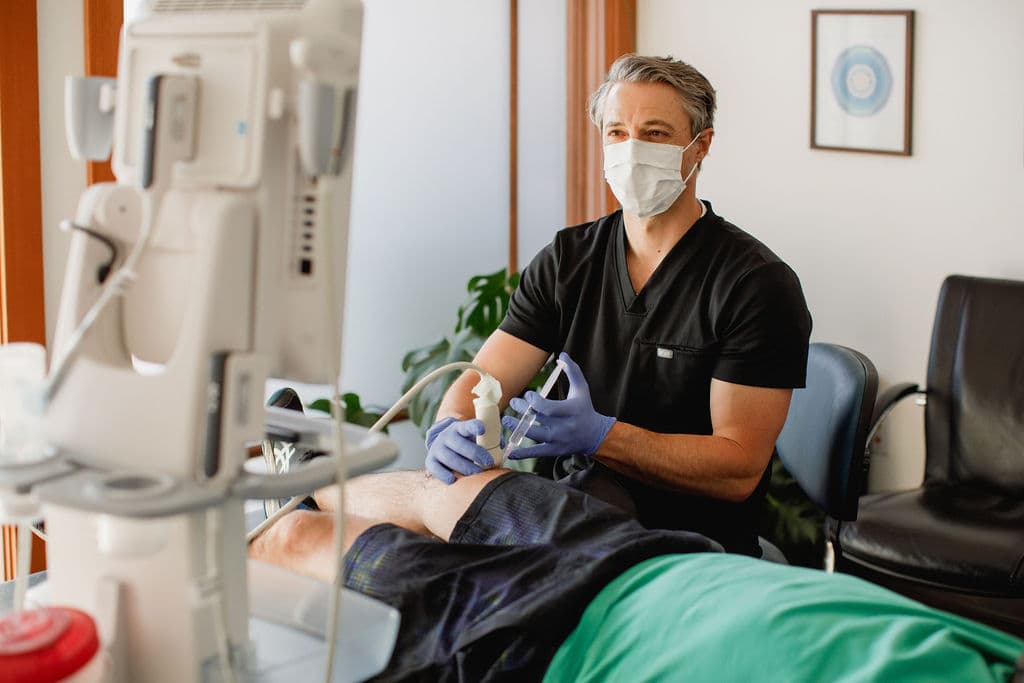
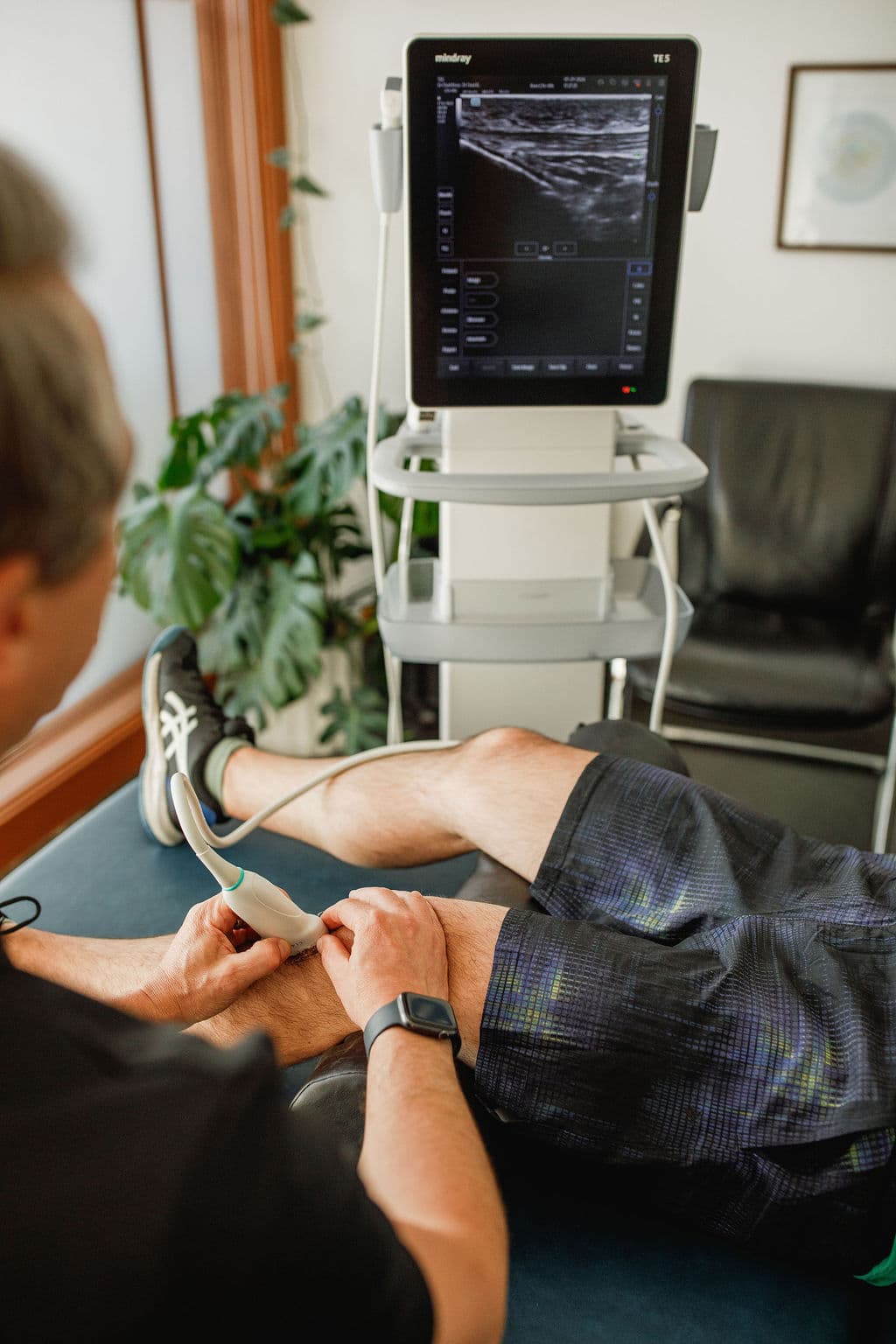
Platelet-Rich Plasma (PRP) therapy concentrates the platelets and growth factors from a small sample of your own blood and delivers them directly into the knee joint under ultrasound guidance. The goal is to calm inflammation and support the joint environment — helping reduce pain and improve how the knee moves and loads.
PRP is not a way to reverse arthritis or regrow cartilage, and it is not right for every knee. It tends to work best in earlier-to-moderate arthritis. Dr. Borys gives you a straightforward assessment of whether PRP is a reasonable option for your knee, based on your exam and imaging.
Knee osteoarthritis tends to progress over time, and repeated cortisone shots can accelerate cartilage loss rather than slow it. For patients who have already tried standard options, PRP is a reasonable next step to discuss.
Many arthritic knees also show a degenerative meniscus tear on MRI. That finding rarely changes the plan — the arthritis is usually the pain driver, and the research shows surgery for these tears does not help.
Why patients consider PRP for knee arthritis
For mild-to-moderate knee arthritis, PRP offers something a cortisone or gel shot can't: a way to support the joint's own healing rather than just easing pain for a few weeks.
Walk further without stopping to rest the knee
Get through a full night without waking from joint pain
Return to hiking, gardening, or stairs without bracing yourself for it
A non-surgical option to consider while the joint is still a good candidate, using your own biology
Address the joint environment — not just quiet the pain for a few weeks
An outpatient option that does not require surgery, general anesthesia, or a long recovery
Is knee PRP right for you?
PRP can be a reasonable option for the right knee, but it isn't ideal for everyone. A consultation and exam help determine whether it fits your situation.
Knee PRP may be a good fit if you
- Have mild-to-moderate knee osteoarthritis with knee pain
- Have not had lasting relief from rest, therapy, bracing, or other conservative care
- Want a non-surgical option that uses your own biological material
- Can allow several weeks to months for a gradual response
Less likely to be appropriate if you
- Expect a guaranteed result from very advanced, "bone-on-bone" arthritis — many still improve, but the response is less predictable
- Need immediate or guaranteed pain relief
- Have an active infection, certain blood or platelet disorders, or active cancer
- Cannot pause anti-inflammatory medications when advised
This list is a general guide, not medical advice. Dr. Borys will review your history, imaging, and goals to recommend the most appropriate option for your knee.
Sounds like your situation?
An initial evaluation covers your imaging, exam findings, and whether PRP is the right option for your knee.
What to expect after a knee PRP injection
The most common reason patients lose confidence after PRP is not that it failed — it is that nobody told them what weeks one through three actually feel like.
Expect a flare
Increased soreness, swelling, or stiffness at the knee for up to a week is normal — it is the inflammatory response the injection is designed to trigger. Reduce activity to keep discomfort manageable, but strict rest is not necessary.
Activity as tolerated: if pain is above a 2 out of 10, dial back and build up again.
The quiet phase
The flare settles but clear improvement may not be noticeable yet. The joint environment is remodeling. Most patients feel close to their pre-injection baseline — that is normal and expected at this stage.
Avoid NSAIDs throughout this window. They suppress the inflammatory cascade PRP depends on.
Gradual improvement
Most patients notice reduced pain with walking, stairs, and daily activity, and less morning stiffness. Improvement is gradual — continue activity as tolerated and build steadily.
Full response window
Peak benefit for knee osteoarthritis typically develops between 3 and 6 months, with good results lasting 1–2 years in appropriate candidates. Dr. Borys reassesses at this point to review the response and whether further treatment makes sense.
If a second injection was planned as part of a series, the timing is usually discussed at this visit.
The research on PRP for knee osteoarthritis
Knee osteoarthritis is one of the most studied uses of PRP. Recent placebo-controlled trials and network meta-analyses generally favor PRP for mild-to-moderate (Kellgren-Lawrence grade I–III) knees, and increasingly suggest that how the PRP is prepared — especially the platelet dose — matters as much as whether PRP is used at all. These studies help explain why PRP is a reasonable option for appropriately selected knees.
PRP for Knee OA: Meta-Analysis of RCTs
Meta-analysis of randomized trials (Dai et al., 2017) comparing PRP with hyaluronic acid for knee osteoarthritis — similar at 6 months, with PRP showing significantly better pain relief and function at 12 months.
Read on PubMedPRP vs Hyaluronic Acid — 5-Year RCT
Double-blind RCT with 5-year follow-up (Di Martino et al., Am J Sports Med, 2019): both PRP and hyaluronic acid improved symptoms significantly. PRP showed favorable signals including lower reintervention rates at 24 months and a trend toward sustained benefit over the longer follow-up period.
Read on PubMedPRP Superior to HA and Cortisone at Longer Follow-Up
Comparative effectiveness study (Oeding et al., Arthroscopy, 2024) comparing PRP with hyaluronic acid and corticosteroid for knee osteoarthritis — PRP showed superior pain and function outcomes at longer-term follow-up, adding to the body of evidence favoring PRP over conventional injectables when durability matters.
Read on PubMedWhy study results sometimes seem to disagree
Research on PRP is mixed, partly because PRP preparations vary widely. Some studies using lower-dose preparations have been negative — for example, the RESTORE trial (JAMA2021) found PRP no better than saline for pain or cartilage at 12 months, using a preparation of only about 1.6× baseline platelets. Other trials and meta-analyses suggest better outcomes when PRP is prepared and dosed appropriately.
A recent placebo-controlled meta-analysis of 18 RCTs (Bensa et al., Am J Sports Med, 2025) found clinically meaningful pain and function gains with PRP — and a clear dose-response: preparations above roughly one million platelets/µL delivered durable benefit through 12 months, while low-platelet preparations often did not. A large 5-year, sham-controlled RCT of 610 patients (Chu et al., Knee Surg Sports Traumatol Arthrosc, 2022) reported benefit sustained over multiple years alongside less cartilage volume loss. And a network meta-analysis of injectable options (Jawanda et al., Arthroscopy, 2024) ranked PRP ahead of hyaluronic acid and cortisone for combined pain and function.
The practical takeaway: PRP is not right for every knee — it tends to help most in earlier-to-moderate arthritis — but a well-prepared, adequately dosed injection placed accurately under ultrasound guidance gives a knee the best chance to respond. Whether your knee is a reasonable candidate depends on what the exam and imaging show.
PRP vs. Stem Cells for Knee Arthritis
Patients often ask whether “stem cells” would work better than PRP for an arthritic knee. It's a fair question — and the honest answer may be surprising.
What “stem cell” injections actually are
The treatments marketed as “stem cells” for arthritis use adult mesenchymal cells harvested from your own fat or bone marrow (BMAC) — not the embryonic stem cells most people picture. Like PRP, their main benefit appears to come from growth factors that may calm inflammation and improve function, rather than from rebuilding cartilage.
How they compare head-to-head
When compared directly, the difference is smaller than the marketing suggests. A 2-year randomized trial of BMAC versus high-dose PRP for knee osteoarthritis found both improved pain and function at every checkpoint, with no significant difference between them.
Why Dr. Borys generally starts with PRP
If outcomes are comparable, the practical factors matter: stem cell procedures often cost several times more than PRP and are more invasive, since harvesting cells from fat or bone marrow carries more risk than a simple blood draw. For most knees that makes PRP a sensible first step. These treatments aren't interchangeable for every patient, so Dr. Borys reviews your situation and gives you a straight answer about what is — and isn't — worth it for your knee.
Knee OA treatment — Bellingham, WA
Based in Bellingham, Dr. Borys sees patients from Whatcom County, Skagit County, the San Juan Islands, and surrounding Northwest Washington communities.
Related conditions
Patellar tendinopathy
Anterior knee pain at the base of the kneecap — often confused with arthritis but a different structure.
Plantar fasciitis
Heel and arch pain driven by fascial degeneration — similar regenerative treatment principles.
PRP therapy
Learn how platelet-rich plasma works, what the preparation involves, and which conditions it is most supported for.
Shockwave therapy
Non-invasive acoustic-wave treatment sometimes used alongside PRP for joint and tendon conditions.
PRP for Knee Osteoarthritis: Common Questions
Does PRP actually work for knee osteoarthritis?
For appropriately selected patients, the research is encouraging. Multiple randomized controlled trials and meta-analyses have found that PRP injections can produce meaningful improvements in knee pain and function compared with controls, and some studies show benefit lasting 12 months or longer.
Its strongest role is in relieving pain and restoring function rather than acting as a cure, and it tends to work best in earlier-to-moderate knee osteoarthritis rather than end-stage, bone-on-bone disease. For many people that relief is enough to stay active and delay more invasive options. Dr. Borys reviews your symptoms, exam, and imaging to give you an honest assessment of whether PRP is a reasonable option for your knee.
How many PRP injections will my knee need?
Many knee osteoarthritis protocols use a short series of 2–3 injections, often spaced 1–2 weeks apart, and some research suggests a series works better than a single injection for the knee.
The right number depends on the severity of your arthritis and how you respond. Dr. Borys reviews your exam and imaging to recommend either a single treatment or a series, and progress is typically reassessed over the following 6–12 weeks.
Is PRP better than cortisone or hyaluronic acid for knee arthritis?
They work differently. A cortisone shot can calm a flared, painful knee quickly, but relief is usually short-lived and repeated steroid injections may not be ideal for the joint over time. Hyaluronic acid ("gel" injections) lubricates the joint.
PRP tends to work more gradually, but when it helps, the benefit is often more durable. A 5-year follow-up RCT comparing PRP and hyaluronic acid for knee osteoarthritis found PRP a reasonable option in selected patients. PRP is not a fit for every knee — Dr. Borys helps you weigh the options for your specific situation.
What stage of knee arthritis responds best to PRP?
Mild-to-moderate knee osteoarthritis generally responds better to PRP than severe, end-stage arthritis where the joint space is largely gone ("bone on bone"). Patients with significant remaining cartilage and pain driven by inflammation and early degeneration tend to be better candidates.
If your arthritis is very advanced, PRP may offer limited benefit, and Dr. Borys will tell you honestly when another option — including referral for surgical evaluation — may serve you better.
How soon will my knee feel better after PRP, and how long does it last?
PRP is a gradual process, not an instant fix. Mild soreness or swelling in the knee for a few days afterward is normal. Many patients begin noticing clearer improvement around 6–12 weeks, with continued change over several months.
When PRP is effective for knee osteoarthritis, research suggests benefits often peak around 3–6 months and can last 12 months or longer, especially in earlier-stage arthritis. Some patients choose to repeat treatment if symptoms return.
Is PRP for knee arthritis covered by insurance in Bellingham?
PRP is not covered by insurance and is an out-of-pocket expense, as most plans still classify it as investigational. The initial evaluation, however, is a standard office visit that may be billed through insurance depending on your individual plan and coverage.
Dr. Borys offers PRP for knee osteoarthritis in Bellingham, WA, serving patients throughout Whatcom County and the surrounding region. Pricing and whether PRP is clinically appropriate for your knee are reviewed at your initial visit.
Knee pain that has outlasted everything else you've tried?
That starts with a thorough look at your knee: imaging review, functional exam, and a frank conversation about what you've already tried. PRP is only recommended when your presentation and the evidence both support it. The initial visit is a standard medical evaluation that may be billed through insurance depending on your plan and coverage.