Calcific Tendinitis Treatment in Bellingham, WA
Calcium deposits in the rotator cuff cause acute, severe shoulder pain. Cortisone may reduce inflammation temporarily, but does not remove the deposit. Dr. Borys uses shockwave therapy — one of the better-studied non-invasive options — to target the calcium directly and support the tendon's own repair.
Book an initial visitA calcium deposit problem, not just a tendon problem
Calcific tendinitis occurs when calcium phosphate crystals accumulate within the rotator cuff tendons — most commonly the supraspinatus — creating a deposit that causes pain, inflammation, and restricted shoulder movement. The pain can range from a chronic dull ache to an acute, disabling flare when the deposit begins to resorb spontaneously.
The condition is more common than most people realize — studies suggest calcium deposits are present in around 3–20% of adults, though many are asymptomatic. When symptomatic, it tends to affect people between 30 and 60 years old and is more common in women. The dominant shoulder is involved more often.
Cortisone injections can reduce acute inflammation but do not resorb the deposit. Radial shockwave therapy — with supportive clinical trial evidence — is one non-invasive option for targeting the deposit directly. The strongest evidence for resorption comes from focused, higher-energy protocols; radial shockwave shows benefit in trials, particularly for pain and function.
Shockwave has more trial data for calcific tendinitis than for most tendon conditions. It is a reasonable next step when cortisone or physical therapy has not provided lasting relief, and it avoids surgery for a condition that often responds well to non-invasive intervention.
Why patients consider this
- Reach overhead, sleep on the affected side, or dress without sharp shoulder pain
- Address the calcium deposit directly rather than relying on cortisone for temporary relief
- A treatment approach aimed at the deposit itself, not just symptom suppression
- Avoid surgery for a condition that responds well to non-invasive intervention in most cases
What Dr. Borys offers for calcific tendinitis
Radial Shockwave Therapy
Radial shockwave therapy is a non-invasive treatment with supportive clinical evidence for reducing pain, improving shoulder function, and in some patients, reducing the size of the calcium deposit. The strongest evidence for calcium resorption comes from focused, higher-energy shockwave protocols — radial shockwave has also shown benefit in clinical trials, though the effect on resorption is less consistent. It is a reasonable option when cortisone or physical therapy has not provided lasting relief.
Learn more about shockwave therapyPRP Injection
PRP may be considered when significant rotator cuff degeneration or tearing accompanies the calcification — not as a treatment for the calcium deposit itself, but to support the underlying tendon tissue. Evidence for PRP directed at the calcium deposit remains limited, so it is not routinely recommended for every case. Whether it is appropriate is determined at evaluation based on ultrasound findings.
Learn more about PRP therapyConservative care alongside shockwave
Shockwave targets the deposit directly, but supporting the surrounding tendon and shoulder mechanics matters for full recovery. Activity modification, rotator cuff strengthening, and scapular stabilization work are integrated into the treatment plan from the start.
Most patients are not expected to wait through months of failed conservative care before shockwave is considered — unlike conditions where loading rehabilitation is the primary treatment, calcific tendinitis has a specific structural target that shockwave addresses directly.
Activity modification
Temporarily avoiding overhead loading and provocative positions reduces pain during acute flares and allows the shoulder to settle before more active treatment.
Physical therapy
Targeted rotator cuff strengthening and scapular stabilization exercises support the shoulder's load-bearing capacity and are combined with in-office treatment for better overall outcomes.
Anti-inflammatory measures
Ice, NSAIDs, and activity modification can reduce acute pain during a flare but do not address the deposit itself. They are reasonable short-term measures while arranging definitive treatment.
Shockwave when conservative care stalls
When pain persists despite rehab and activity modification — or when the deposit is large and symptomatic — shockwave is a reasonable next step to consider.
Ultrasound-guided needling and lavage
In selected cases — particularly when a deposit is soft and fluid — ultrasound-guided needle puncture and lavage (barbotage) is a minimally invasive procedural option. Dr. Borys can help determine whether shockwave is appropriate or whether referral for lavage or an orthopedic consultation would be more suitable.
What the research says about shockwave for calcific tendinitis
Radial Shockwave, Needling, and Combined Treatment Compared
Single-blind RCT specifically comparing radial shockwave, ultrasound-guided needle puncture, and combined treatment for calcific shoulder tendinitis. All three arms produced calcium resorption and pain reduction at follow-up. This is one of the stronger radial-specific trials for this condition.
View on PubMed →ESWT Superior to Placebo for Calcific Shoulder Tendinitis
Systematic review and meta-analysis by Bannuru et al. (2014) found extracorporeal shockwave therapy significantly superior to sham for pain reduction and calcium resorption. Note: this review includes focused and radial protocols — the strongest effects on resorption are primarily from higher-energy focused trials.
View on PubMed →Durable Benefit at 24 Months Post-Treatment
Wang et al. (2003) followed patients after ESWT for calcific tendinitis and found pain relief and functional improvement maintained at approximately 24 months. This study involved a focused high-energy protocol — results may not directly reflect outcomes from radial shockwave treatment.
View on PubMed →Who tends to benefit most
A reasonable fit if you…
- Have confirmed calcific tendinitis on X-ray or ultrasound with ongoing shoulder pain
- Have not had lasting relief from a cortisone injection or physical therapy alone
- Want a treatment that targets the calcium deposit rather than temporarily suppressing symptoms
- Are trying to avoid surgical needling or rotator cuff decompression procedures
May not be the right fit if you…
- —Have early or small asymptomatic deposits found incidentally — watchful waiting is often appropriate
- —Have a large full-thickness rotator cuff tear alongside the calcification that may need surgical repair
- —Need a guaranteed outcome — calcific deposits vary in density and some respond more slowly than others
- —Have an active infection, certain blood or platelet disorders, or active cancer (for injection options)
Related conditions
Shoulder pain overview
Compare calcific tendinitis, rotator cuff tendinopathy, and frozen shoulder side by side to see which pattern fits.
Rotator cuff tendinopathy
Calcific tendinitis often co-exists with rotator cuff tendinopathy — Dr. Borys uses ultrasound to distinguish the two and tailor treatment accordingly.
Frozen shoulder
Adhesive capsulitis can develop in the same shoulder — the two conditions can co-exist and it is worth confirming which is driving the pain.
Calcific Tendinitis Treatment: Common Questions
Can shockwave therapy reduce the calcium deposit?
Yes — studies show that shockwave can promote partial or complete resorption in some patients, although results vary by deposit type and treatment protocol. Follow-up imaging may show partial or complete reduction of the deposit.
The strongest evidence for resorption comes from higher-energy focused shockwave protocols. Radial shockwave also has supportive trial data, including at least one RCT showing deposit reduction. The acoustic stimulus is thought to alter the deposit and stimulate a local biological response that helps the body gradually clear it — though the precise mechanism is not fully established. Results vary by deposit density, size, and morphology.
How many shockwave sessions are needed for calcific tendinitis?
Most protocols for calcific tendinitis use 3–6 sessions, typically spaced one week apart. This differs from other tendon conditions where shockwave is used — calcific tendinitis generally requires a dedicated series rather than a single treatment.
Dr. Borys uses diagnostic ultrasound to assess the deposit before treatment and on follow-up to gauge resorption progress. The number of sessions is adjusted based on how the deposit and the shoulder are responding.
Why not just get a cortisone injection for calcific tendinitis?
Cortisone may reduce acute pain and inflammation around the deposit, and it is a reasonable option when other measures have not provided enough relief. However, it does not directly affect the calcium itself — the deposit remains, and pain often returns.
Shockwave targets the deposit directly, and randomized trials have shown calcium resorption alongside pain relief — most consistently with focused, higher-energy protocols. For patients looking to address the structural problem rather than manage symptoms temporarily, it is a more targeted approach. Cortisone still has a role in managing acute severe flares, but it is not a long-term solution on its own.
Is calcific tendinitis different from a rotator cuff tear?
Yes — they are distinct conditions, though they can co-exist. A rotator cuff tear involves a structural disruption of the tendon fibers. Calcific tendinitis involves calcium phosphate crystal deposits within an otherwise intact (or less severely damaged) tendon.
Diagnostic ultrasound and X-ray distinguish the two clearly. Dr. Borys performs in-office ultrasound at the initial evaluation to confirm whether you have calcification, tendon degeneration, a tear, or a combination — because the treatment approach differs significantly depending on what is actually present.
Is calcific tendinitis treatment covered by insurance in Bellingham?
The initial evaluation is a standard office visit that may be covered depending on your insurance plan. Shockwave therapy and PRP injections are generally not covered by insurance and are paid out of pocket, as most plans still classify them as investigational.
Dr. Borys treats calcific tendinitis in Bellingham, WA, serving patients from Whatcom County, Skagit County, and the San Juan Islands. Pricing and treatment options are reviewed at your initial visit.
Calcific tendinitis treatment in Bellingham, WA
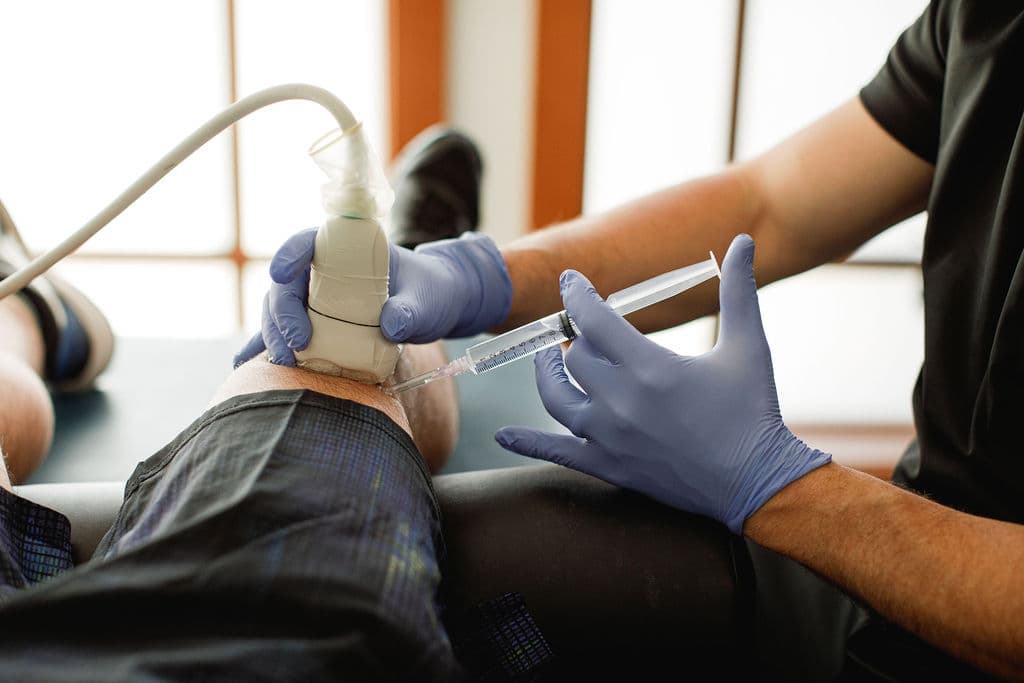
Dr. Borys treats calcific tendinitis at his clinic in Bellingham using ultrasound-guided shockwave therapy and, where appropriate, PRP. Diagnostic ultrasound confirms the size and density of the deposit before any treatment is planned, and progress is assessed on follow-up.
Patients come from across Whatcom County, Skagit County, and the San Juan Islands.
Start with a full shoulder evaluation
An initial visit includes a full shoulder examination and diagnostic ultrasound to confirm the deposit and assess the surrounding tendon. Dr. Borys will review whether shockwave, PRP, or a combination is appropriate for your presentation.
The information on this page is for general educational purposes only and is not individual medical advice. It is not a substitute for a consultation with a qualified provider. Whether a treatment is appropriate depends on your individual evaluation, and individual results vary.