Proximal Hamstring Tendinopathy Treatment in Bellingham, WA
Deep buttock pain that worsens with sitting, running, or loading the hip is often the hamstring tendon at its origin — not a simple muscle strain. A targeted loading program is the foundation of treatment, with shockwave and PRP as well-evidenced options when more is needed.
Book an initial visitA tendon problem, not a muscle problem
Bottom line
Proximal hamstring tendinopathy is degeneration of the hamstring tendon at the sit bone — not a muscle tear and not a nerve problem, though it can be mistaken for both. A well-designed loading program targeting the hamstrings at length is the most evidence-backed approach. Shockwave has randomized trial support for active individuals, and PRP is a reasonable next step when loading has not been enough. This condition resolves slowly; a structured, patient approach produces the most durable outcomes.
The three hamstring muscles — biceps femoris, semimembranosus, and semitendinosus — share a common tendon origin at the ischial tuberosity, the bony prominence you sit on. When this tendon is repeatedly loaded beyond its capacity, it undergoes degenerative changes rather than clean inflammation. The result is chronic pain at the sit bone that is distinctly worse with sitting, especially on hard or low surfaces, and with explosive hip-loading movements like sprinting, deep lunging, and rowing.
What makes this tendon challenging to treat is that the movements that load it most — sitting, forward bending, and hip flexion under load — are difficult to avoid entirely. Aggressive hamstring stretching, one of the most common instincts when the posterior thigh hurts, compresses the tendon against the bone and often prolongs the problem rather than solving it.
Diagnostic ultrasound lets Dr. Borys visualize the tendon directly — assessing the degree of degeneration, ruling out partial tearing, and distinguishing a tendon problem from sciatic nerve involvement or referred pain from the lumbar spine, which can present in a very similar distribution.
Why patients consider this
A layered approach, led by loading
Loading Program
Tendon-specific loading — targeting the hamstrings at length, in hip flexion — is the foundation of treatment and the approach with the most consistent evidence. Getting the angles, loads, and progression right matters more than the volume of exercise.
What to expect at your visitShockwave Therapy (ESWT)
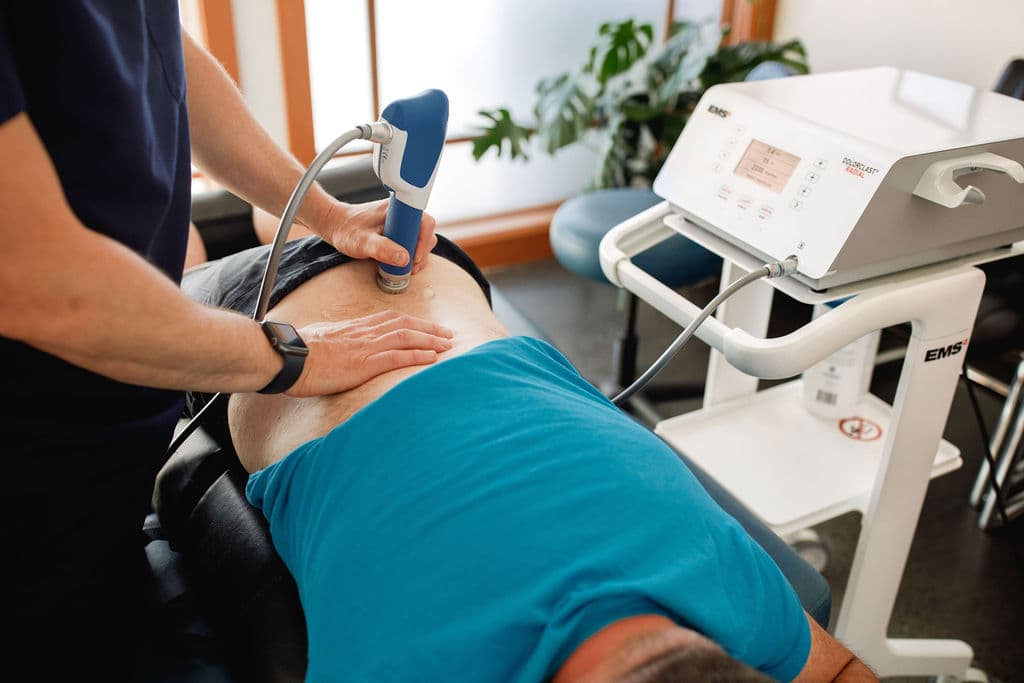
A 2024 systematic review in the British Journal of Sports Medicine concluded that ESWT may be effective for proximal hamstring tendinopathy in athletes, while noting that further high-level research is needed. A 2025 systematic review of hip and pelvis tendinopathies further supports ESWT as a reasonable treatment option. Dr. Borys uses it alongside a structured loading program rather than as a replacement for rehabilitation.
Learn more about shockwave therapyPRP Injection
Ultrasound-guided PRP injection at the proximal hamstring origin is a reasonable next step when loading and shockwave have not produced adequate progress. PRP is placed directly at the tendon insertion under real-time imaging to confirm accurate placement.
Learn more about PRP therapyLoading, not rest
Complete rest does not resolve tendon degeneration — it removes the stimulus the tendon needs to remodel. The goal is to reduce provocative compression while introducing progressive loads at the angles that drive structural improvement.
The specific joint angles matter. Hamstring loading in hip flexion — not end-range stretching — is what produces the mechanical stimulus for tendon remodeling. The program is progressive and based on tendon response, not a fixed weekly schedule.
Reduce high-load hip-flexion positions
Deep hip flexion — sitting on low chairs, climbing steep hills, forward-trunk lunging — places the hamstring tendon under compressive load at its origin. Temporarily modifying these positions lets the tendon settle enough to respond to loading.
Tendon-specific loading at length
A progressive loading program targeting the hamstrings with the hip in flexion drives tendon remodeling. The specific angles and load progression matter; a generic stretching routine does not produce the same effect.
Lumbopelvic stabilization
Weakness or poor control through the glutes and lumbopelvic region increases demand on the hamstring tendon. Strengthening these proximal structures is part of a complete program and reduces recurrence.
Shockwave and PRP when loading alone stalls
When a well-executed loading program has plateaued, shockwave and PRP are evidence-supported next steps. They work best alongside continued loading — not as replacements for it.
What the research shows
Review Supports a Multimodal Rehabilitation Approach
A 2023 systematic review concluded that conservative care may be best optimized by combining tendon-specific loading at increased muscle length, lumbopelvic stabilization, and ESWT. The authors noted that research on conservative treatment outcomes remains limited.
View on PubMed →ESWT May Help Proximal Hamstring Tendinopathy in Active Individuals
A 2024 British Journal of Sports Medicine systematic review found Level I studies suggesting ESWT may be effective on its own for proximal hamstring tendinopathy in athletes and physically active adults. The authors also concluded that further high-level research is needed to better define its role and clinical outcomes.
View on PubMed →Shockwave Supported for Hip and Pelvis Tendinopathies
A 2025 HSS Journal systematic review included five studies of proximal hamstring tendinopathy and concluded that ESWT may be safe and effective for hip and pelvis tendinopathies. The authors called for further research using validated outcomes and standardized treatment parameters.
View on PubMed →Is this the right approach for you?
A good fit if you...
May not be the right fit if you...
What to expect over time
Load reduction and early isometrics
The first priority is calming the tendon by modifying compressive hip-flexion positions — low chairs, steep inclines, aggressive hip stretching. Isometric hamstring contractions at tolerable angles are introduced to maintain tendon stimulus without provocative loading.
Avoid prolonged sitting in deep hip flexion and refrain from aggressive stretching — both compress the proximal tendon against the ischial tuberosity and can delay recovery.
Progressive loading at length
The core of the program: progressive isotonic loading targeting the hamstrings with the hip in increasing flexion angles. Nordic curls, Romanian deadlifts, and single-leg variations are typical progressions. Load is increased as the tendon adapts.
Shockwave if indicated
For patients not progressing adequately with loading alone, shockwave is introduced in this window — typically 4–6 sessions. It is most effective alongside a continued loading program rather than as a standalone passive treatment.
If PRP is planned, it is typically placed in this window after adequate loading preparation. Post-injection soreness of 3–7 days is expected.
Return to full activity
Return to running, sport, and heavy loading is progressive and guided by tendon response. Proximal hamstring tendinopathy is a slow-resolving condition — three to six months is a realistic timeline for a meaningful reduction in symptoms, with full return to high-demand activity often taking longer.
Recurrence is common when loading is ramped up too quickly or when lumbopelvic stabilization is neglected. A maintenance program protects the gains.
Protecting your progress
Avoid aggressive hamstring stretching
Stretching the hamstring in a forward-bend position compresses the proximal tendon against the ischial tuberosity. This is one of the most common mistakes during recovery and can significantly prolong symptoms.
Sitting modifications matter
Prolonged sitting — especially on hard or low surfaces — loads the tendon at length for hours at a time. A wedge cushion that tilts the pelvis forward, or raising the seat height, reduces this compression meaningfully.
Load progression, not rest
Complete rest does not resolve tendon degeneration. Progressive loading at the right angles and intensities is what drives structural improvement. The goal is to keep the tendon working at a tolerable level throughout recovery.
Expect a long recovery window
Proximal hamstring tendinopathy is among the slower-resolving tendon problems. A three-to-six month commitment to the loading program, with patience around setbacks, is realistic and worth it.
Common questions
Proximal Hamstring Tendinopathy Treatment: Common Questions
What is proximal hamstring tendinopathy?
Proximal hamstring tendinopathy is degeneration of the hamstring tendon at its origin on the ischial tuberosity — the sit bone. It is caused by repetitive tensile and compressive loading that outpaces the tendon's capacity to repair, leading to pain with sitting, hip-flexion loads, and explosive lower-body movements like sprinting or lunging.
Why does sitting make it worse?
Sitting places the hamstring tendon under simultaneous tensile and compressive load at its origin. Prolonged sitting — particularly on hard or low surfaces — sustains this load for extended periods. This is one of the key reasons proximal hamstring tendinopathy is common in cyclists, rowers, and desk workers, and why modifying sitting position is part of treatment, not just activity restriction.
Is stretching helpful?
Counterintuitively, aggressive hamstring stretching often worsens proximal hamstring tendinopathy. Forward-bending stretches compress the proximal tendon against the ischial tuberosity at the same time as placing it under tension — a combination that increases compressive load at exactly the site of pathology. Targeted loading at controlled angles is more effective and safer than stretching during the early and middle phases of recovery.
How long does recovery take?
Proximal hamstring tendinopathy is one of the slower-resolving tendon conditions. A structured loading program typically produces meaningful improvement at three to six months, with return to full high-demand activity often taking longer. Chronicity, load history, and consistency with the program are the main variables.
When does shockwave or PRP make sense?
Shockwave is most appropriate after a 6–8 week period of structured loading has not produced adequate progress. PRP is considered when both loading and shockwave have been trialed appropriately. Both are used alongside continued loading rather than as passive standalone treatments — in the research, the strongest outcomes come from combining these options with a rehabilitation program.
Start with a full hamstring tendon evaluation
Dr. Borys will confirm the diagnosis with examination and ultrasound, establish where you are in the recovery process, and discuss whether a loading program, shockwave, PRP, or a combination is the right next step.
The information on this page is for general educational purposes only and is not individual medical advice. It is not a substitute for a consultation with a qualified provider. Whether a treatment is appropriate depends on your individual evaluation, and individual results vary.