Gluteal Tendinopathy & Lateral Hip Pain Treatment in Bellingham, WA
If outer-hip pain has been waking you at night, limiting your walking, or making it impossible to sit comfortably, the problem is usually the tendon — and often deeper than bursitis. A loading-based plan has outperformed cortisone in a major trial, and PRP has some of the strongest randomized evidence of any tendon.
Book an initial visitWhy does the outer hip become painful?
Bottom line
Lateral hip pain is one of the most common hip complaints — greater trochanteric pain syndrome affects a large share of adults in midlife and later, women most often. It is usually a tendon problem — gluteal tendinopathy — not simple “bursitis.” Education plus a progressive strengthening program has the strongest evidence and has outperformed a cortisone shot in a major trial. When that is not enough, this tendon also responds well to shockwave and PRP — PRP has some of the strongest randomized evidence of any tendon, with benefit sustained at two years.
The gluteus medius and minimus muscles attach by their tendons to the greater trochanter — the bony point you feel on the outer hip. These tendons stabilize your pelvis every time you stand on one leg, walk, or climb stairs. When they're loaded or compressed more than they can tolerate, they become painful and tender, often making it hard to lie on that side at night.
For years this was labeled “trochanteric bursitis,” but research has shown the tendons themselves — not an inflamed bursa — are usually the real source. That's why the condition is often called greater trochanteric pain syndrome, and why calming a bursa alone rarely fixes it. Compression of the tendon against the bone is a key driver, so how you load the hip matters as much as how strong it is.
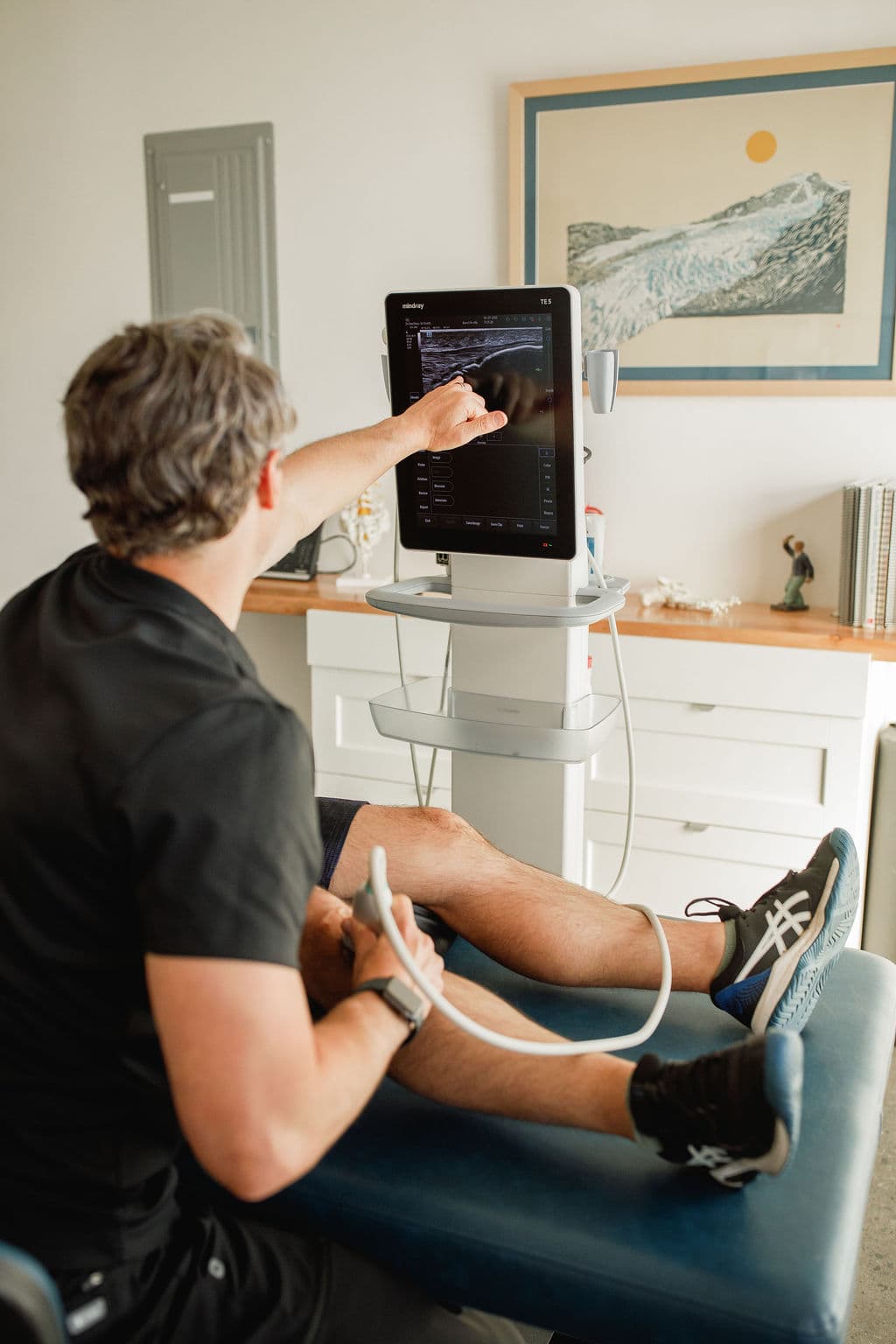
Where it adds useful information, diagnostic ultrasound lets Dr. Borys look directly at the gluteal tendons — checking for degeneration or tearing, assessing the nearby bursa, and helping distinguish a tendon problem from hip-joint or low-back causes.
Gluteal tendons in a chronic degenerative state don't resolve with rest alone, and cortisone shots — while commonly offered — have been outperformed by exercise at one year in a major clinical trial. The longer the tendon stays unloaded and untreated, the longer the path back to comfortable movement. For more on how PRP fits into that picture, see how PRP therapy offers hope for gluteal tendinopathy pain.
What a structured approach offers
Gluteal tendinopathy responds best to a clear plan carried out consistently. The goal is to settle the tendons, rebuild their strength, and get you back to comfortable walking and sleep — without chasing quick fixes.
Sleep on that side again without waking from outer-hip pain
Walk a full flight of stairs or a longer trail without favoring the hip the whole way
Get back to the exercise routine that has been on hold for months
A program that explains exactly what compresses the tendon — so you can stop doing it
PRP with some of the strongest randomized evidence of any tendon, benefit held at two years
A plan built on a landmark trial that outperformed cortisone at one year
Education and loading come first — and they work
For gluteal tendinopathy, managing compression and progressively strengthening the tendons isn't a warm-up before the “real” treatment — it is the treatment that helps most people. Procedures are the exception, not the plan.
Procedures are for the hip that has already done the program
Compression management, load modification, and a progressive gluteal strengthening program are the right first steps — and in a landmark trial, that approach outperformed a cortisone injection both early on and at one year. Shockwave and PRP earn their place when good-faith rehab hasn't been enough. For lateral hip pain that has already outlasted weeks of consistent effort, a targeted intervention is a reasonable next move. PRP in particular has a double-blind trial behind it for this tendon — a single injection outperformed corticosteroid, and that benefit held at two years.
The options, in order of evidence
Education and loading are the foundation. When they aren't enough, the in-office options below are well-supported next steps for this tendon — each backed by randomized evidence.
Education & Loading Program
Reducing tendon compression in daily life combined with a progressive gluteal strengthening program is the best-supported treatment — and in head-to-head trials it outperformed a corticosteroid injection. This is the foundation of care.
Explore conditions treatedShockwave Therapy (ESWT)
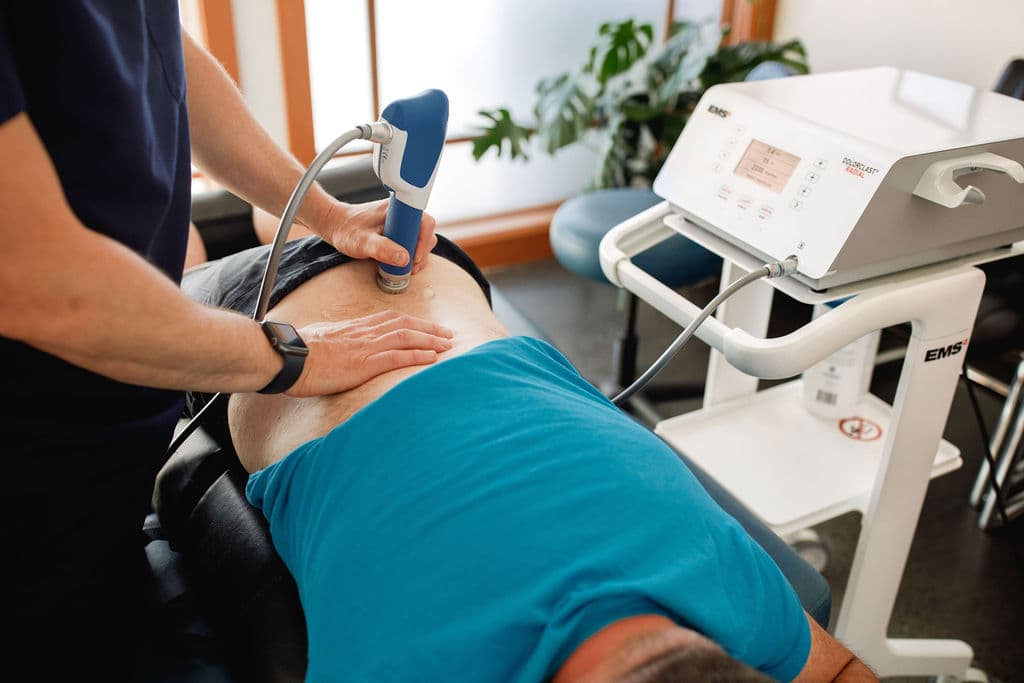
Radial shockwave delivers acoustic pressure waves to the tendon non-invasively and works well alongside a strengthening program. In a 2024 meta-analysis of randomized trials, shockwave could complement or serve as an alternative to corticosteroid injection for greater trochanteric pain.
Learn more about shockwave therapyPRP Injection
Gluteal tendinopathy has strong PRP evidence: in a double-blind trial, a single ultrasound-guided PRP injection outperformed corticosteroid and the benefit was sustained at two years. A well-supported option when exercise alone has not been enough.
Learn more about PRP therapyWhat to expect during recovery
Gluteal tendinopathy recovery is measured in months. Knowing what each phase looks like helps you stick with the program long enough for it to work.
Post-injection soreness
Increased aching over the outer hip for up to a week is expected — it is the inflammatory response the injection is meant to trigger. Reduce compressive loads (crossing legs, sitting on hard surfaces) and keep activity to a tolerable level.
Activity as tolerated: if pain is above a 2 out of 10, ease back. Avoid NSAIDs. Continue the loading program only as directed by Dr. Borys.
Load management and early rehab
Pain-free sitting and walking gradually improve. The loading program — isometrics progressing to isotonics — is the main driver of recovery at this stage. PRP works alongside the loading, not instead of it.
Compressive positions (hip adduction, deep hip flexion) remain restricted until the tendon has calmed sufficiently.
Progressive loading
Most patients notice meaningful improvement with stairs, walking, and sleeping on the affected side. Heavier loading and return to sport or exercise is typically introduced in this window as the tendon tolerates it.
Full response and maintenance
Tendon effects take 3–4 months to be fully appreciated, with benefits continuing to one year in the Fitzpatrick trial. Consistency with load management protects the gains — stopping the program too early is the most common reason symptoms return.
Dr. Borys reassesses at 3 months to confirm the tendon is responding and adjust loading as needed.
Day-to-day recovery principles
Improvement is measured in months
Tendons adapt gradually. An education-and-exercise program typically runs at least three months, with gains continuing beyond that — in the research, benefits were still present at one year.
Mind the compressive positions
A big part of recovery is managing daily load: how you sit, stand, and sleep. Reducing compression over the outer hip lets the tendons calm down so strengthening can work.
Some discomfort with loading is okay
A tolerable level of tendon discomfort during and after strengthening is generally acceptable, as long as it settles and does not steadily worsen day to day.
Consistency beats intensity
Stopping the program as soon as pain eases is a common reason symptoms return. Sticking with load management and strengthening protects the gains you have made.
Is this approach right for your hip?
A loading-led plan helps most people with gluteal tendinopathy, but lateral hip pain can have other sources. A consultation and exam help determine what fits your situation.
This approach may fit if you
- Have lateral hip pain and tenderness over the outer hip that has lasted weeks to months
- Notice pain lying on the hip, climbing stairs, or standing on one leg
- Want an evidence-based plan rather than a quick cortisone shot
- Can commit to load management and a progressive strengthening program
Less likely to be appropriate if you
- Have pain coming mainly from the hip joint itself (such as hip osteoarthritis)
- Have pain that radiates from the low back or appears to be nerve-related
- Need immediate, guaranteed pain relief
- Are looking for a one-visit fix rather than a rehabilitation-led approach
This list is a general guide, not medical advice. Dr. Borys will review your history, exam and goals to recommend the most appropriate approach for your hip.
If that sounds like your hip, a conversation is the right next step.
An initial evaluation covers your history, exam, and a plan built around what is actually driving the pain.
What the evidence says
The research is consistent: education and exercise are first-line and outperform a cortisone shot over time, while shockwave and PRP have real support as adjuncts for this tendon. That evidence shapes how Dr. Borys makes recommendations.
LEAP Trial: Education + Exercise vs Corticosteroid
Landmark randomized trial (Mellor et al., BMJ, 2018) in which an education-plus-exercise program produced greater global improvement and less pain than a corticosteroid injection or a wait-and-see approach for gluteal tendinopathy, with benefits sustained at one year.
Read on PubMedEfficacy of Gluteal Tendinopathy Treatments
Systematic review (Bremer et al., Clinical Rehabilitation, 2025) concluding that exercise and education are the core approach for pain and function, potentially supplemented by shockwave therapy, which showed superior long-term pain relief versus corticosteroid injection in the reviewed trials.
Read on PubMedPRP vs Corticosteroid: Double-Blind RCT
Double-blind randomized controlled trial (Fitzpatrick et al., American Journal of Sports Medicine, 2018) in which a single ultrasound-guided PRP injection produced significantly greater improvement at 12 weeks than a corticosteroid injection for chronic gluteal tendinopathy (82% of PRP patients improved).
Read on PubMedPRP Benefit Sustained at 2 Years
Two-year follow-up of the same double-blind RCT (Fitzpatrick et al., American Journal of Sports Medicine, 2019) showing the improvement from a single LR-PRP injection was sustained at 2 years, whereas the corticosteroid benefit peaked at 6 weeks and was not maintained beyond 24 weeks.
Read on PubMedESWT for Greater Trochanteric Pain: Meta-Analysis
Systematic review with meta-analysis of randomized trials (Rhim et al., JBJS Reviews, 2024) concluding that focused shockwave therapy can complement or serve as an alternative to corticosteroid injection and exercise, while noting that larger high-quality trials are still needed.
Read on PubMedReferences are provided for education and transparency and do not represent a guarantee of any particular outcome. Study populations, exercise protocols, and injection preparations vary, and individual results differ.
Why not just get a cortisone shot?
It's a fair question — cortisone is commonly offered for lateral hip pain. The issue is what happens after the first few weeks.
What a cortisone shot does
A corticosteroid injection is anti-inflammatory and can provide short-term relief from lateral hip pain. But gluteal tendinopathy is mainly a tendon-load problem, not an inflammatory one, so a shot doesn't address the underlying cause — and the benefit tends to fade.
What the trials show
In the LEAP trial, an education-and-exercise program clearly outperformed a corticosteroid injection at one year, and repeated steroid around a tendon raises concerns about weakening the tissue. So Dr. Borys favors a loading-based plan, and when an injection is warranted he uses PRP — not cortisone — which beat corticosteroid in a double-blind trial and held up at two years.
Lateral hip pain treatment — Bellingham, WA
Based in Bellingham, Dr. Borys sees patients from Whatcom County, Skagit County, the San Juan Islands, and surrounding Northwest Washington communities.
Gluteal Tendinopathy & Lateral Hip Pain Treatment: Common Questions
What is gluteal tendinopathy and how is it different from trochanteric bursitis?
Gluteal tendinopathy is an overload problem of the gluteus medius and minimus tendons where they attach to the greater trochanter — the bony point on the outer hip. It is now understood to be the main driver of what used to be called "trochanteric bursitis." While a bursa near those tendons can become irritated, research shows the tendons themselves are usually the primary problem, which is why the broader term greater trochanteric pain syndrome (GTPS) is often used.
The distinction matters for treatment: because the issue is mainly tendon overload and compression rather than simple inflammation, the most effective approach is load management and progressive strengthening — not just calming a bursa. Dr. Borys uses diagnostic ultrasound to look at the tendons directly and confirm what is actually generating your lateral hip pain.
What does treatment for gluteal tendinopathy involve?
The best-supported treatment is a combination of education and progressive exercise. In a landmark randomized trial (the LEAP trial, BMJ 2018), an education-plus-exercise program produced better global improvement and less pain than a corticosteroid injection — and far better results than waiting it out — at both 8 weeks and one year. Education focuses on reducing tendon compression (for example, how you sit, stand, and sleep), while the exercise program gradually rebuilds the strength and capacity of the gluteal tendons.
For cases that do not respond to a consistent program, in-office options such as shockwave therapy or PRP can be considered. Dr. Borys starts with the load-based plan that has the strongest evidence and adds procedures only when they are genuinely warranted.
Does shockwave therapy work for lateral hip pain?
There is reasonable support for it. A 2025 systematic review in Clinical Rehabilitation found that focused shockwave therapy (f-ESWT) showed superior long-term pain improvement compared with corticosteroid injection for gluteal tendinopathy, and concluded that exercise and education form the core approach and can be supplemented by shockwave or other options.
That makes shockwave a reasonable non-invasive adjunct for lateral hip pain that has stalled despite a good exercise program. It is typically used alongside continued strengthening rather than on its own. Dr. Borys will give you a straightforward read on whether it is a sensible addition in your case.
Does PRP work for gluteal tendinopathy?
The evidence for PRP in gluteal tendinopathy is more encouraging than for some other tendons. A systematic review found PRP injections to be more effective than corticosteroid injections for greater trochanteric pain syndrome that has not responded to conservative care, and it appears to be a reasonable injectable option in that setting. That said, the authors note the literature still needs more large, high-quality trials.
Because of this, Dr. Borys treats PRP as a considered option for stubborn cases rather than a routine first step. Any recommendation is made after an exam and ultrasound, with a clear conversation about what the current evidence does and does not establish.
Why does my hip hurt more when lying on my side or climbing stairs?
These positions load and compress the gluteal tendons against the greater trochanter. Lying on the painful side compresses the tendons directly, while lying on the opposite side lets the top leg drop and stretches them across the bone. Stairs, hills, standing on one leg, and sitting with crossed legs all increase compression and load at the tendon attachment, which is why they tend to flare the pain.
Understanding this is a core part of treatment. A major focus of the education component is reducing these compressive positions during daily life so the tendon can settle and respond to strengthening. Simple changes — like a pillow between the knees at night or avoiding crossing your legs — often make a meaningful difference.
How long does gluteal tendinopathy take to get better?
Like other tendinopathies, gluteal tendinopathy is slow to recover, and improvement is usually measured over months rather than weeks. An education-and-exercise program is typically carried out over at least three months, with gains continuing beyond that. In the LEAP trial, the benefits of the education-plus-exercise approach were still evident at one year.
Consistency is the key variable. Reducing tendon compression in daily life and sticking with the progressive strengthening program — rather than stopping as soon as pain eases — is what produces durable results. Dr. Borys helps set realistic expectations and adjusts the plan based on how your hip is responding.
Is gluteal tendinopathy treatment covered by insurance in Bellingham?
The initial evaluation is a standard office visit that may be billed through insurance depending on your individual plan and coverage. Regenerative injections such as PRP, along with shockwave therapy, are generally not covered and are paid out of pocket, as most plans still classify them as investigational.
Dr. Borys treats lateral hip pain and gluteal tendinopathy in Bellingham, WA, serving active adults throughout Whatcom County and the surrounding region. Pricing and which approach is most appropriate for your hip are reviewed at your initial visit.
Outer-hip pain that has been limiting you for months?
Gluteal tendinopathy is frequently misdiagnosed as hip bursitis or referred lumbar pain. Getting the right answer before committing to a treatment matters. The initial visit establishes what is driving your symptoms and whether PRP, a structured loading program, or both makes sense — a standard medical evaluation that may be billed through insurance depending on your plan and coverage.