Patellar Tendinopathy Treatment in Bellingham, WA
Chronic jumper's knee can keep flaring despite rest, stretching, and rehab. Dr. Borys uses ultrasound evaluation, progressive loading guidance, PRP, and radial shockwave therapy to match treatment to what your tendon actually needs.
Book an initial visitWhat is patellar tendinopathy?
Patellar tendinopathy — often called jumper's knee — is chronic pain and degeneration of the patellar tendon at or just below its attachment to the kneecap. It develops from repetitive loading that outpaces the tendon's capacity to adapt: common in jumping athletes, runners, and active adults whose training volume spikes faster than their tendons can keep up with.
Unlike an acute tear, patellar tendinopathy is a failed-healing problem. The tendon develops disorganized collagen, neovascularization, and focal tendinosis rather than inflammation in the classical sense — which is why anti-inflammatory treatments (including corticosteroid injections) tend to provide only temporary relief and may weaken the tendon with repeated use.
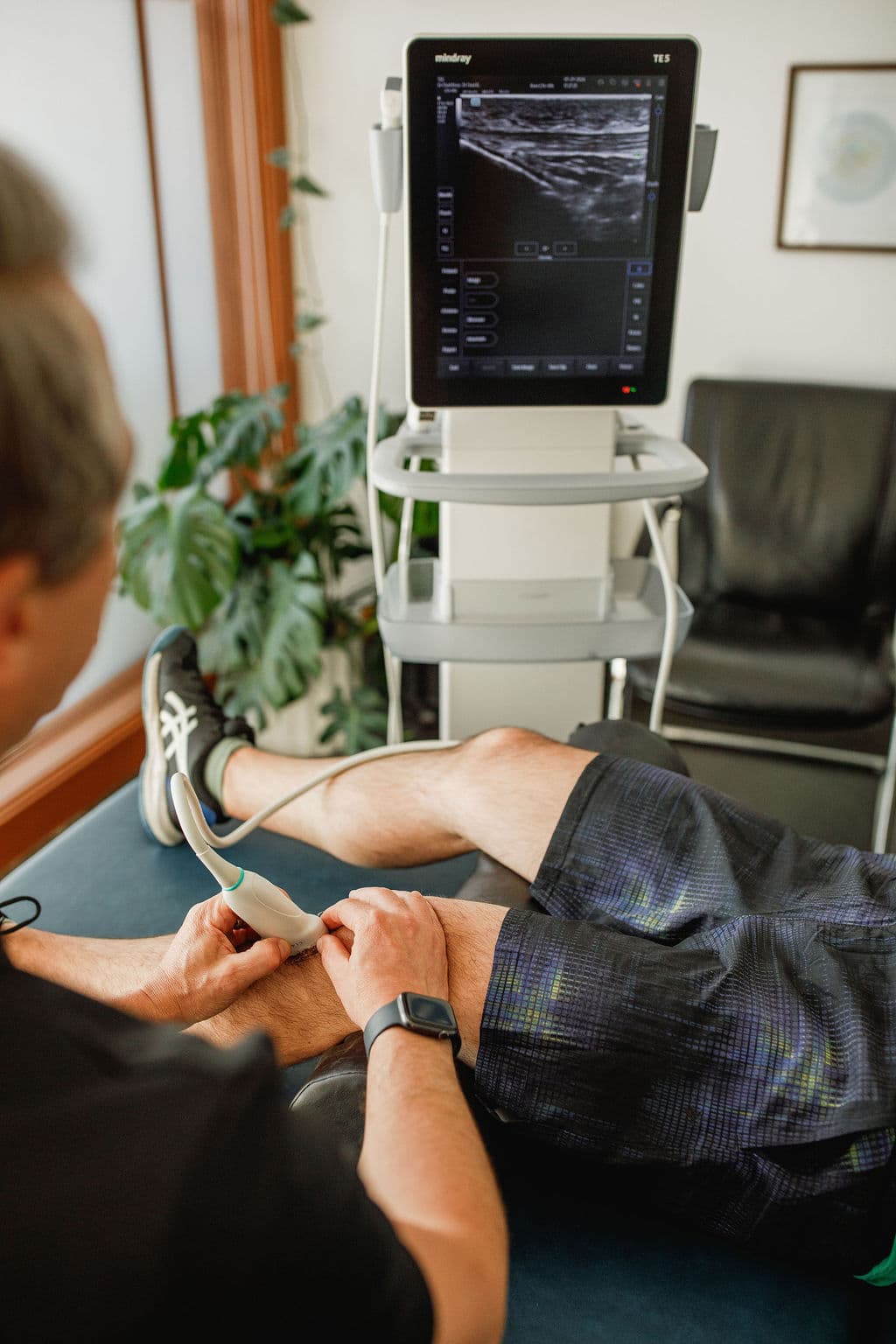
PRP addresses this directly: it delivers a concentrated dose of your own growth factors into the tendinotic tissue under ultrasound guidance, supporting the tendon's own repair process. When combined with a structured loading program, the evidence shows it accelerates recovery compared to loading alone.
Tendons stuck in a degenerative state don't simply resolve with time. Athletes who delay addressing chronic patellar tendinopathy often find the window for conservative recovery closes, and what could have been managed with loading and PRP becomes a longer rehabilitation. Earlier intervention typically means an earlier return to the sport you've been sidelined from.
Bottom line
PRP and shockwave have the strongest role when chronic tendon pain has plateaued despite a structured loading program. Both have randomized trial support for patellar tendinopathy, and a 2024 study found combining them outperformed PRP alone.
How patellar tendinopathy is treated
Loading is always the foundation. The in-office options below are well-supported next steps for tendons that have plateaued on rehab — each backed by randomized evidence.
Progressive Loading Program
Eccentric and heavy-slow resistance loading is the best-evidenced treatment for patellar tendinopathy. It rebuilds the tendon's capacity and is the foundation of care for every case — whether or not an injection is added.
Common questions about treatmentShockwave Therapy (ESWT)
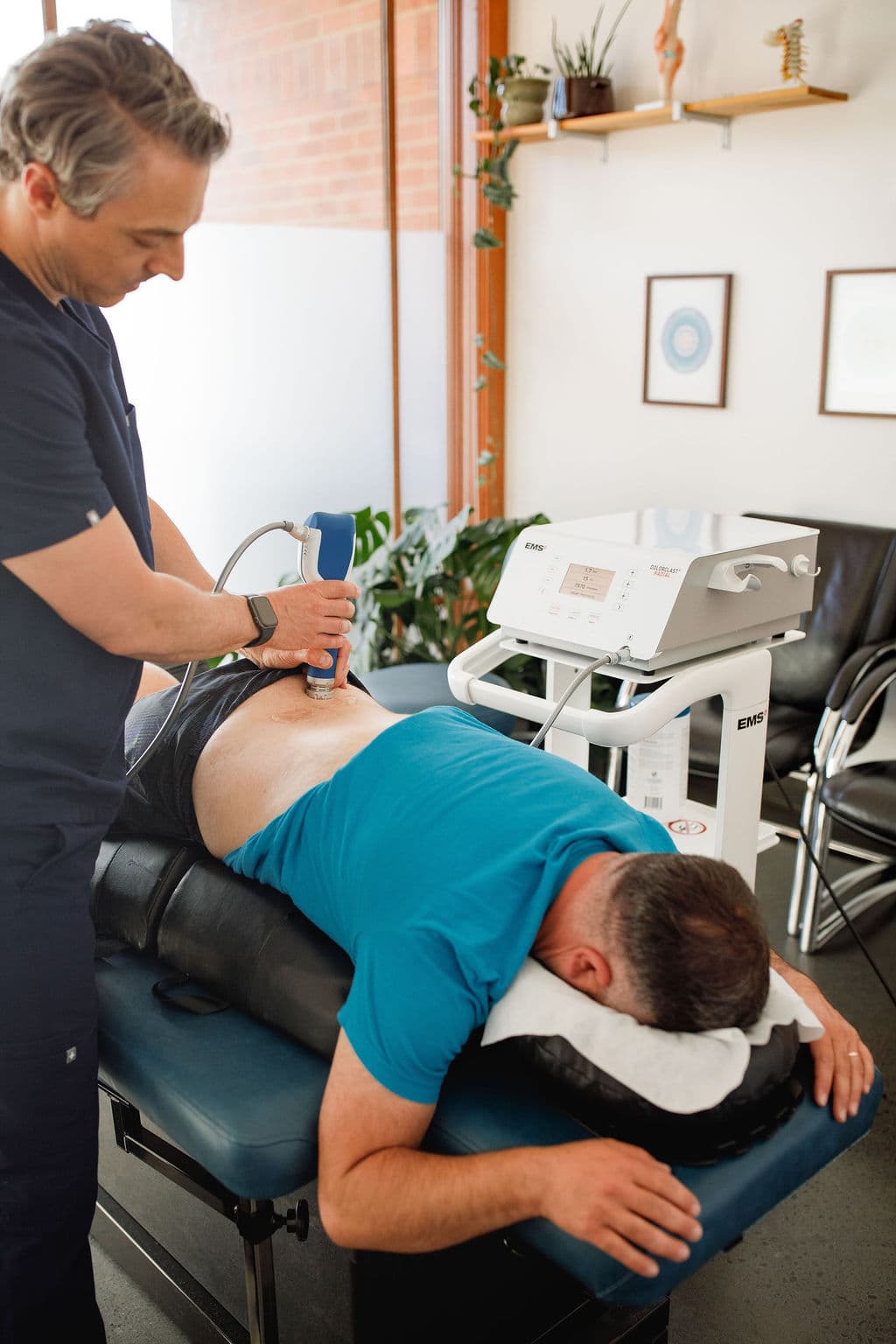
Radial shockwave delivers acoustic pressure waves to the patellar tendon to stimulate repair. It may be a reasonable adjunct for persistent patellar tendinopathy — a 2024 study found combining ESWT with PRP outperformed PRP alone — though the evidence here is less established than for conditions such as plantar fasciitis or calcific shoulder tendinopathy.
Learn more about shockwave therapyPRP Injection
Ultrasound-guided PRP concentrates your own growth factors and delivers them into the area of tendinosis. When combined with a structured loading program, a double-blind RCT showed PRP accelerated return to sport compared to exercise alone.
Learn more about PRP therapyWhat to expect after a patellar tendon PRP injection
Patellar tendon healing is measured in months. Knowing what each phase looks like helps you work with the response rather than against it.
Expected post-injection flare
Increased tenderness and aching below the kneecap for up to a week is normal — it is the inflammatory response the injection is designed to trigger. Reduce training load and keep activity to a tolerable level.
Activity as tolerated: if pain is above a 2 out of 10, ease back. Avoid NSAIDs during this window.
Reload gradually
The loading program remains the backbone of recovery. Isometric holds are typically tolerated first, progressing to isotonic and then sport-specific loading as the tendon settles. PRP is working in the background.
Many patients feel close to pre-injection baseline by week two — that is normal, not a sign of failure. Returning to sport during this window is the most common setback.
Measurable improvement
Most patients report meaningful reduction in pain with jumping, landing, and loading the knee. Return-to-sport progressions typically begin in this window for athletes who have maintained their loading program.
Full response and return to sport
Tendon effects take 3–4 months to be fully appreciated. The 2023 PRP + ESWT combination trial measured outcomes at 3 and 6 months — that is the relevant timeframe. Dr. Borys reassesses at 12 weeks to confirm the tendon is ready for full loading.
If shockwave was part of the plan, the combined benefit continues to accumulate through this window.
Supporting your recovery
Expect some tendon soreness
Increased soreness around the patellar tendon for a few days is normal and expected — it reflects the healing response the injection is designed to trigger.
Continue your loading program
Eccentric and heavy-slow resistance exercises remain the backbone of recovery. PRP works best as a complement to a structured loading program, not a replacement for it.
Avoid NSAIDs around the injection
Hold off on anti-inflammatories like ibuprofen around the time of your injection — they can blunt the platelet-driven healing response.
Improvement takes weeks to months
Tendon healing is gradual. Most patients notice meaningful improvement between 6 and 12 weeks, with continued gains over three to six months as the tendon remodels.
The research on PRP and shockwave for patellar tendinopathy
PRP alone versus saline has been negative in one well-designed trial, but PRP combined with an eccentric loading program outperforms loading alone. The key finding is that PRP works best as a complement to structured loading, not a replacement for it — and that combining PRP with shockwave improves on either treatment alone.
LR-PRP + Eccentric Loading vs Exercise Alone
Double-blind RCT (Dragoo et al., Am J Sports Med, 2014) in which PRP plus dry needling combined with a standardized eccentric exercise program accelerated return to sport and produced better VISA-P scores vs exercise alone, supporting PRP as an adjunct to loading rather than a standalone treatment.
Read on PubMedPRP Combined with Shockwave vs PRP Alone
Comparative study (Knee Surg Relat Res, 2024) analyzing PRP alone versus PRP combined with ESWT for chronic patellar tendinopathy. Combined treatment produced superior outcomes, reinforcing shockwave as a meaningful adjunct to PRP.
Read on PubMedPRP for Jumper's Knee: Comprehensive Review
Systematic review (Eur J Orthop Surg Traumatol, 2023) concluding that PRP holds promise for patellar tendinopathy and may promote tendon healing, while noting the importance of protocol standardization for reliable outcomes.
Read on PubMedComparative Injection Treatments for Patellar Tendinopathy
Systematic review (Sports Health, 2024) finding that LP-PRP and dry needling showed potential for short-to-medium-term benefit in patellar tendinopathy, supporting a combined approach over single-modality injection.
Read on PubMedWhy PRP results for this tendon vary
The most frequently cited negative trial (Scott et al., Am J Sports Med, 2019) compared LR-PRP to saline and found no difference. Critically, that trial did not standardize the loading program alongside the injection — and the current understanding is that PRP for patellar tendinopathy works by amplifying a loading stimulus, not by replacing it. When combined with a structured eccentric or heavy-slow resistance program, the outcomes improve meaningfully.
The 2024 PRP+ESWT comparison adds further weight: combining treatments outperformed PRP alone. The practical framing is that neither PRP nor shockwave is a standalone cure — but as part of a well-structured rehabilitation plan, both have a clear and evidence-backed role.
A note on corticosteroid injections for patellar tendinopathy
Cortisone injections are not recommended for patellar tendinopathy by most sports medicine guidelines. The tendon in this condition is not primarily inflamed — it has undergone degenerative changes (tendinosis) — and corticosteroid does not address that pathology. Worse, repeated injections around a tendon are associated with weakening of the tendon tissue and increased rupture risk.
This is part of why PRP is a meaningful alternative: it targets the same tendon with the goal of supporting repair. When Dr. Borys considers an injection for patellar tendinopathy, PRP is the option with both the evidence and the biological rationale behind it.
Is PRP or shockwave right for your patellar tendon?
These treatments tend to help most in chronic cases where a structured loading program has been tried but the tendon has not fully recovered.
This may be a good fit if you
- Have chronic patellar tendon pain lasting more than 3 months
- Have not had lasting relief from a structured eccentric loading program
- Are an athlete or active adult wanting to return to sport
- Have chronic patellar tendon pain consistent with tendinopathy on exam
This is a general guide. Dr. Borys reviews your history, loading patterns, and exam findings to determine whether PRP, shockwave, or a revised loading program is the right next step for your knee.
If that sounds like your knee, a conversation is the right next step.
An initial evaluation covers your loading history, exam, and exactly which treatment approach fits where you are.
Patellar Tendinopathy Treatment (Jumper's Knee): Common Questions
Does PRP work for patellar tendinopathy (jumper's knee)?
The evidence is mixed depending on how PRP is used. A well-cited double-blind trial (Scott et al., AJSM 2019) found PRP no better than saline when used as a standalone injection — but that trial did not standardize a loading program alongside treatment. The current understanding is that PRP works best as a complement to structured loading, not a replacement for it.
When combined with an eccentric exercise program, a separate randomized trial (Dragoo et al., AJSM 2017) found that PRP plus dry needling accelerated return to sport compared with exercise alone. And a 2024 study found that combining PRP with shockwave produced superior outcomes to PRP alone. The honest summary: PRP is not a magic fix for this tendon, but as part of a well-structured plan it has clear randomized support.
How is treatment for patellar tendinopathy decided?
Progressive loading — eccentric exercises and heavy-slow resistance training — has the strongest and most consistent evidence for patellar tendinopathy, and is the starting point for nearly every case. It builds the tendon's capacity to handle load, which is the core problem.
For chronic cases that have genuinely plateaued after several months of good loading, shockwave therapy and PRP are the most evidence-backed next steps. Shockwave is non-invasive and has strong support for chronic patellar tendinopathy. PRP works best when combined with continued loading rather than used alone. Cortisone injections are not recommended for this tendon — guidelines advise against them because the condition is degenerative rather than inflammatory, and repeated steroid use around tendons carries rupture risk.
How long does patellar tendinopathy take to recover?
Patellar tendinopathy is characteristically slow to recover. Most patients following a structured loading program begin seeing meaningful improvement over three to six months, with full return to sport often taking longer in high-load athletes.
PRP and shockwave do not shorten recovery to weeks, but they can accelerate progress in tendons that have stalled. The most important variable is consistency with loading: stopping the program as soon as pain eases is the most common reason for relapse.
Is shockwave therapy effective for jumper's knee?
Yes — shockwave has good evidence for chronic patellar tendinopathy. Focused extracorporeal shockwave therapy (ESWT) stimulates the tendon's own repair response, and controlled trials support its use for cases that have not responded to conservative care. It is non-invasive, performed in office, and can be used as a standalone treatment or combined with PRP, where a 2024 study found the combination superior to PRP alone.
Is patellar tendinopathy treatment covered by insurance in Bellingham?
The initial evaluation is a standard office visit that may be covered depending on your insurance plan. PRP injections and shockwave therapy are generally not covered by insurance and are paid out of pocket, as most plans still classify them as investigational.
Dr. Borys treats patellar tendinopathy in Bellingham, WA, serving athletes and active adults throughout Whatcom County. Pricing and treatment options are reviewed at your initial visit.
Patellar tendinopathy treatment — Bellingham, WA
Dr. Chad Borys, ND treats patellar tendinopathy in Bellingham, WA. The plan is clear: a progressive loading program first, with ultrasound-guided PRP and shockwave as well-supported next steps for tendons that have stalled on rehab alone. Dr. Borys sees patients from Whatcom County, Skagit County, the San Juan Islands, and surrounding Northwest Washington communities.
Book an initial visit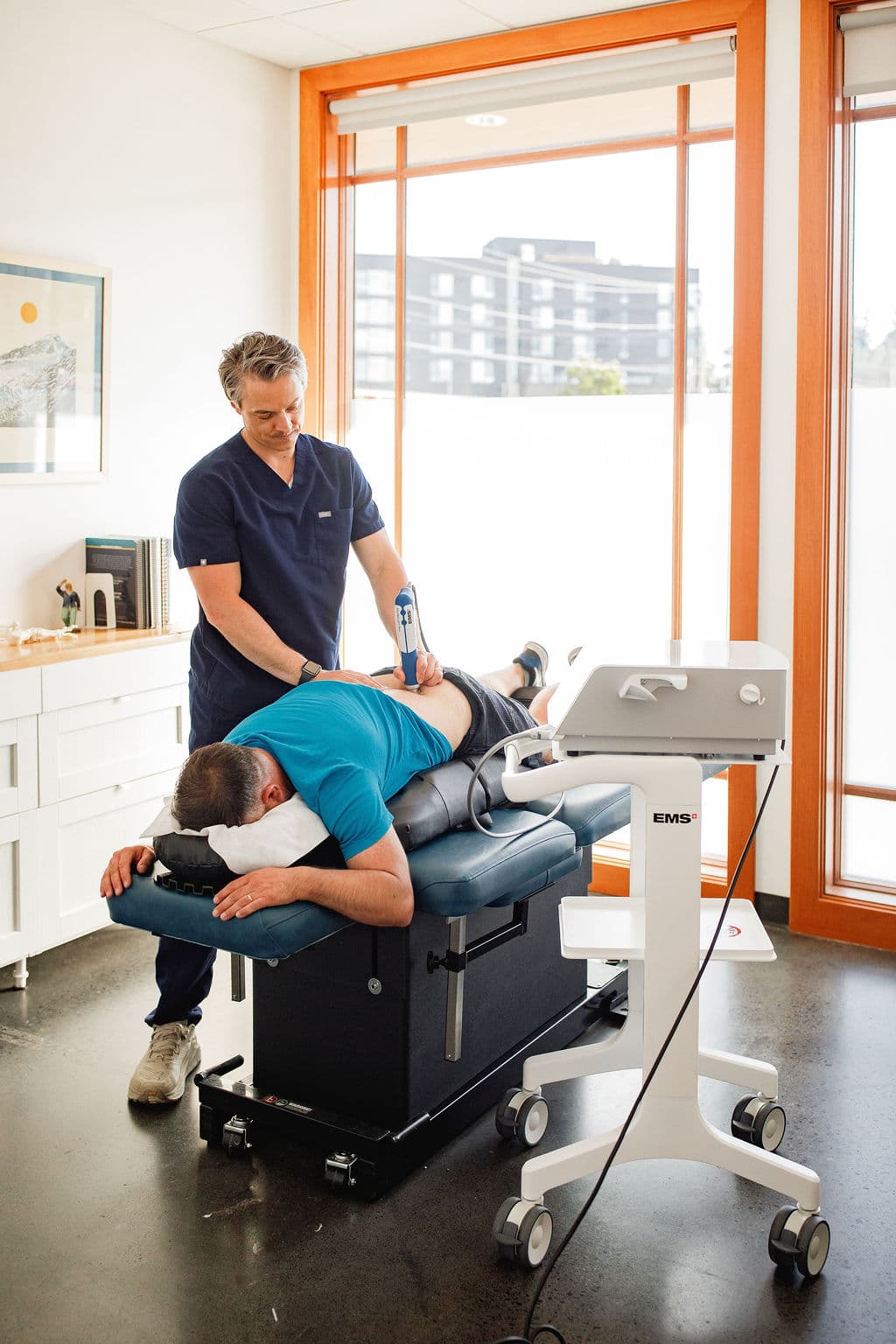
The information on this page is for general educational purposes only and is not individual medical advice. It is not a substitute for a consultation with a qualified provider. Whether a treatment is appropriate depends on your individual evaluation, and individual results vary.