Plantar Fasciitis Treatment in Bellingham, WA
That sharp first-step pain that has been there every morning for months. Shockwave, PRP, and prolotherapy are evidence-supported options for chronic plantar fasciitis when conservative care has not been enough.
Book an initial visitWhy does chronic heel pain stick around?
Bottom line
Most plantar fasciitis resolves with consistent stretching, supportive footwear, and activity modification. For chronic heel pain that persists after several months, shockwave therapy has the strongest evidence and is non-invasive. PRP and prolotherapy are injection-based options for selected cases.
The plantar fascia is a thick band of tissue along the bottom of your foot that supports the arch and absorbs impact with every step. When it's repeatedly overloaded — by long hours on your feet, a jump in activity, unsupportive footwear, tight calves, or foot mechanics — it can develop microscopic tears and degeneration.
Despite the “-itis” in its name, chronic plantar fasciitis isn't mainly an inflammatory problem. In long-standing cases, the fascia can become thickened, disorganized, and slower to repair — blood flow drops and the tissue struggles to restore itself. That's why the classic first-step pain in the morning can drag on for months.
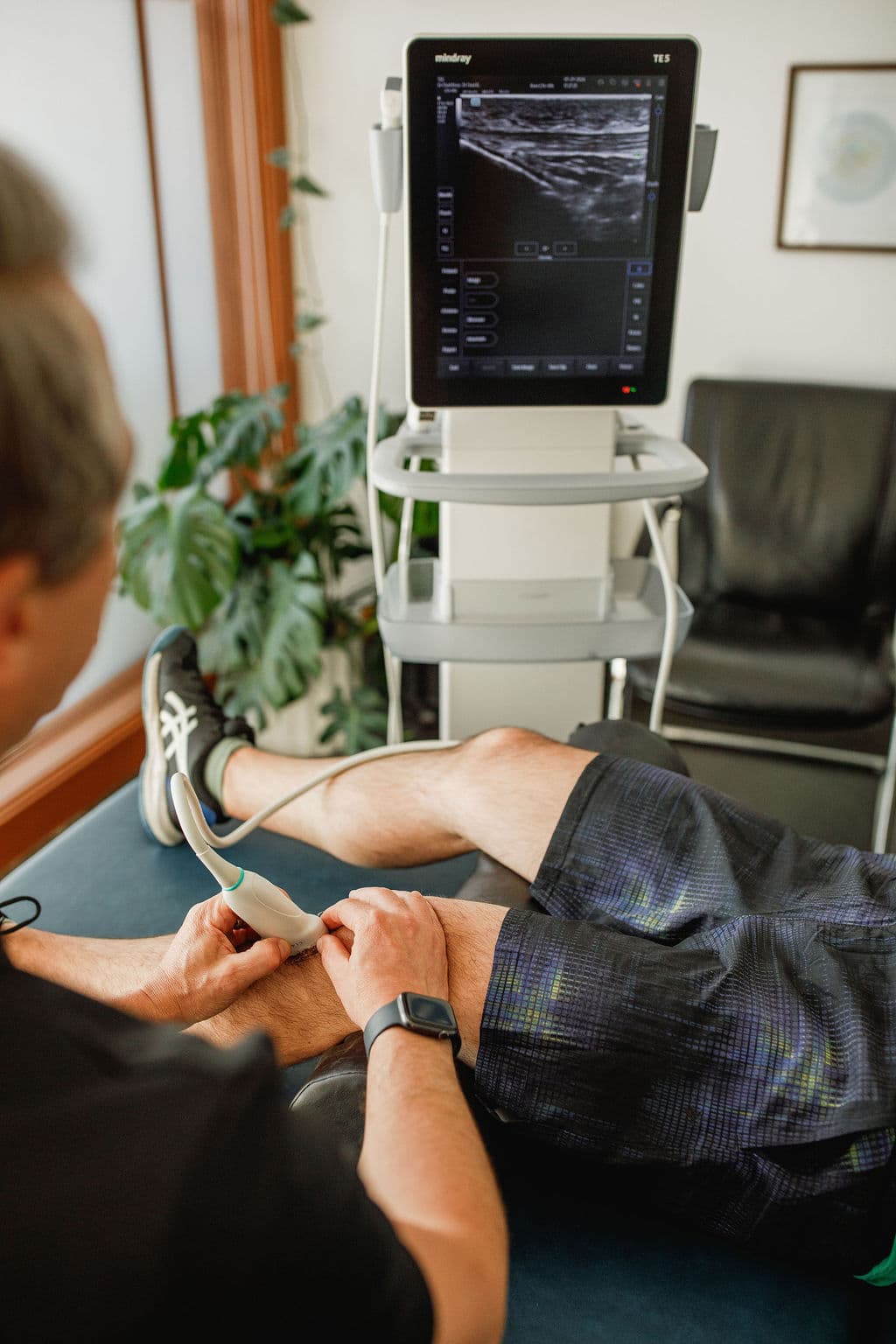
Where it adds useful information, diagnostic ultrasound lets Dr. Borys look directly at the plantar fascia — measuring thickness, identifying degeneration, and helping rule out other causes of heel pain.
When plantar fascia pain has persisted for months despite consistent conservative care, the tissue may be less likely to settle without a more targeted plan — and repeated cortisone shots carry a documented risk of plantar fascia rupture and fat-pad atrophy. For heel pain that has already outlasted stretching and shoes, earlier intervention means a shorter path back to normal activity.
Why patients consider these treatments
For chronic plantar fasciitis, these options offer something repeated cortisone shots don't: a way to support healing in the fascia itself.
Take your first steps in the morning without dreading what comes next
Walk the full block, finish the shift, or finish the run without stopping for the heel
Stop relying on cortisone shots that help for six weeks and then wear off
Address the degenerated fascia itself — not just the pain on top of it
Shockwave: non-invasive, no injection, usually no meaningful downtime — the most supported in-office option
Explore a tissue-directed option before surgery becomes a serious consideration
Where these treatments fit: conservative care comes first
Shockwave and injections are not the first thing to try for heel pain. For most people, a structured, non-invasive plan should come first — and the majority of plantar fasciitis resolves without any procedure.
These treatments are for the heel that has already done the work
Calf and plantar fascia stretching, supportive footwear, and activity modification are the right first steps — and over 90% of plantar fasciitis cases improve with them. Shockwave, PRP, and prolotherapy earn their place when months of consistent conservative effort hasn't produced lasting relief. If your heel has already outlasted stretching routines, night splints, new shoes, and possibly a cortisone shot or two, a targeted in-office option is a reasonable next move before surgery enters the conversation.
Non-surgical options for chronic plantar fasciitis
When conservative care hasn't resolved your heel pain, Dr. Borys matches the treatment to your exam findings. Shockwave is often the first option considered, with PRP and prolotherapy available when injection-based care is a better fit.
Shockwave Therapy (ESWT)
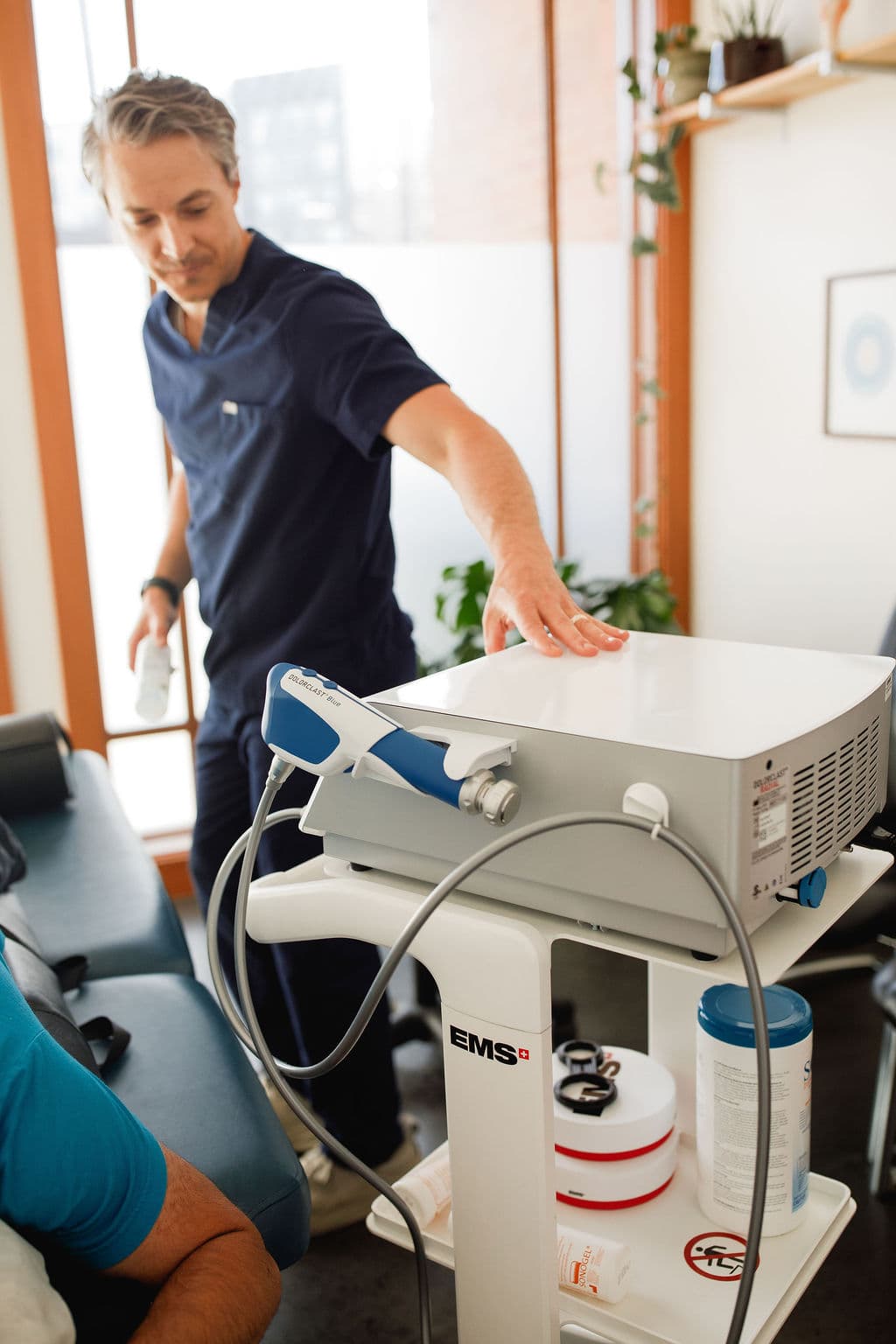
Acoustic pressure waves stimulate blood flow and a healing response in the degenerated fascia. Non-invasive, with no injection — brief activity modification and usually no meaningful downtime, with most patients back to light activity the same day. It is also the best-supported in-office option for chronic plantar fasciitis, which is why it is often considered first.
Learn more about shockwave therapyPRP Injections
Concentrated growth factors from your own blood are placed into the plantar fascia under ultrasound guidance to support genuine tissue repair. Considered for chronic cases that have not responded to rehab and shockwave.
Learn more about PRP therapyProlotherapy
A dextrose-based solution is injected to prompt a localized healing response in the fascia and surrounding tissue. A gentler regenerative option delivered as a short series, appropriate for selected cases.
Learn more about prolotherapyWhat to expect after treatment
Knowing what's normal afterward helps you support your fascia's own healing response.
Mild soreness is normal
Some tenderness in the heel for a day or two after shockwave, or for a few days after an injection, is expected and is part of the healing response.
Ease back into activity
Most patients return to normal walking right away after shockwave; after an injection, brief relative rest is followed by a gradual return to activity and any prescribed rehab.
Keep up your rehab
Continuing your stretching and strengthening program supports whichever in-office treatment you receive and helps protect the result.
Improvement takes time
Plantar fasciitis treatment works gradually. Many patients notice clearer improvement over several weeks, with continued change over a few months as the fascia heals.
Is this treatment right for your heel pain?
These options can help the right foot, but they aren't ideal for everyone. A consultation and exam help determine what fits your situation.
Treatment may be a good fit if you
- Have chronic plantar fasciitis or heel pain that has lasted months
- Have not had lasting relief from stretching, orthotics, and activity changes
- Want a non-surgical option to try before considering more invasive treatment
- Can allow several weeks for a gradual response
Less likely to be appropriate if you
- Have new heel pain that may still respond to rest and rehab
- Need immediate or guaranteed pain relief
- Have an active infection, certain blood or platelet disorders, or active cancer (for injection options)
- Have heel pain from another cause, such as a stress fracture or nerve entrapment, that needs different care
This list is a general guide, not medical advice. Dr. Borys will review your history, exam and goals to recommend the most appropriate option for your foot.
If that sounds like your situation, it's time to find out what the heel actually shows.
An initial evaluation covers your history, exam, and which option fits your heel.
What the evidence says
Plantar fasciitis is one of the better-studied foot conditions. These peer-reviewed studies look at shockwave, PRP, and prolotherapy — the non-surgical options Dr. Borys offers — for chronic heel pain. The evidence is encouraging but still evolving, and no treatment works for every foot.
Radial Shockwave Therapy vs Placebo
Randomized, placebo-controlled multicenter trial (Gerdesmeyer et al., Am J Sports Med, 2008) of 245 patients showing radial extracorporeal shockwave therapy was significantly superior to placebo for chronic plantar fasciitis at 12 weeks and 12 months, with no relevant side effects.
Read on PubMedPRP vs ESWT: Meta-Analysis of RCTs
Systematic review and meta-analysis of 6 randomized trials (Daher et al., Foot Ankle Int, 2024) comparing PRP and shockwave. Both improved pain and fascial thickness; PRP showed a statistically greater pain reduction, though the difference did not reach clinical significance.
Read on PubMedPRP vs Shockwave: 2-Year Follow-Up
Ultrasound-guided comparative study with minimum 2-year follow-up (Alessio-Mazzola et al., J Foot Ankle Surg, 2023). Both PRP and shockwave produced significant improvement; the PRP group had fewer recurrences and, among athletes, a faster return to sport.
Read on PubMedPRP vs Corticosteroid: Meta-Analysis
Systematic review and meta-analysis of 13 RCTs and 901 patients (2025) comparing PRP with corticosteroid injection. Short-term relief was similar, but PRP produced significantly better medium-term outcomes and was recommended as the preferred option for chronic plantar fasciitis.
Read on PubMedDextrose Prolotherapy vs PRP
Ultrasound-guided randomized controlled trial (Kumari et al., Cureus, 2025) comparing 25% dextrose prolotherapy with PRP for plantar fasciitis. Both treatments significantly improved pain and foot function and were found to be minimally invasive and safe options.
Read on PubMedReferences are provided for education and transparency and do not represent a guarantee of any particular outcome. Study populations, PRP and prolotherapy preparations, and shockwave protocols vary, and individual results differ.
Why not just get a cortisone shot?
Cortisone has long been a go-to for stubborn heel pain. It's a fair question — and the honest answer comes down to short-term relief versus the risk of making things worse.
What a cortisone shot does
A corticosteroid injection is anti-inflammatory and can ease heel pain quickly. The trade-off is that the relief is often short-lived and the injection doesn't repair the degenerated fascia — so the pain frequently returns.
Why Dr. Borys limits it
Repeated steroid injections into the plantar fascia carry well-documented risks — including plantar fascia rupture and heel fat-pad atrophy — that can cause worse, longer-lasting problems. For chronic cases, Dr. Borys favors options that support tissue healing over time.
Plantar fasciitis treatment — Bellingham, WA
Based in Bellingham, Dr. Borys sees patients from Whatcom County, Skagit County, the San Juan Islands, and surrounding Northwest Washington communities.
Plantar Fasciitis Treatment: Common Questions
How is treatment for chronic plantar fasciitis decided?
For most people, a structured rehabilitation program — calf and plantar fascia stretching, intrinsic foot strengthening, supportive footwear, and activity modification — resolves plantar fasciitis without any procedure, and it should come first.
When heel pain persists despite several months of consistent conservative care, the next step depends on your exam findings, imaging, and what you have already tried. Shockwave therapy (ESWT) has the strongest body of evidence for chronic plantar fasciitis and is non-invasive. PRP and prolotherapy are injection-based options appropriate in selected cases. Dr. Borys reviews your history and gives you an honest recommendation.
Does shockwave therapy work for plantar fasciitis?
For chronic plantar fasciitis, shockwave therapy (extracorporeal shockwave therapy, or ESWT) is one of the better-supported non-surgical options. It uses acoustic pressure waves to stimulate blood flow and a healing response in the degenerated plantar fascia, with no injection, anesthesia, or downtime.
It is not an instant fix — it is typically delivered as a short series of weekly sessions, and improvement builds gradually over several weeks. Shockwave tends to help most in long-standing heel pain that has not responded to stretching and orthotics. Dr. Borys reviews your ultrasound and history to determine whether shockwave is a reasonable starting point for your foot.
Does PRP work for plantar fasciitis?
PRP (platelet-rich plasma) concentrates the healing platelets from a small sample of your own blood and delivers them, under ultrasound guidance, into the degenerated plantar fascia to support tissue repair. Several randomized trials have found that PRP can produce meaningful, durable improvement in chronic plantar fasciitis — in some studies outperforming corticosteroid injections by six months, because PRP aims to help the tissue heal rather than simply quieting inflammation.
Results vary between studies and PRP is not right for every foot. It is generally reserved for chronic cases that have not responded to rehabilitation and shockwave. Dr. Borys gives you an honest assessment of whether PRP is a reasonable option for your heel pain.
Are cortisone injections bad for plantar fasciitis?
Cortisone (corticosteroid) injections can relieve plantar fasciitis pain quickly by suppressing inflammation, but the relief is often short-lived, and the injection does not repair the degenerated fascia. More importantly, repeated steroid injections into the plantar fascia carry well-documented risks, including plantar fascia rupture and heel fat-pad atrophy — both of which can cause worse, longer-lasting problems than the original condition.
For these reasons, Dr. Borys generally favors treatments that support actual tissue healing — shockwave, PRP, and prolotherapy — for chronic plantar fasciitis, rather than relying on repeated cortisone shots.
Do I need surgery for plantar fasciitis?
Surgery for plantar fasciitis is rarely needed. The large majority of cases resolve with non-surgical treatment, and surgery is generally reserved for the small number of patients who have not improved after many months of comprehensive conservative care.
Non-surgical options such as shockwave, PRP, and prolotherapy aim to address the underlying tissue degeneration without an incision or prolonged recovery. If you have been considering surgery for stubborn heel pain, Dr. Borys recommends exhausting these options first.
Is plantar fasciitis treatment covered by insurance in Bellingham?
Shockwave therapy and regenerative injections such as PRP and prolotherapy are generally not covered by insurance and are paid out of pocket, as most plans still classify them as investigational. The initial evaluation, however, is a standard office visit that may be billed through insurance depending on your individual plan and coverage.
Dr. Borys treats chronic plantar fasciitis in Bellingham, WA, serving patients throughout Whatcom County and the surrounding region. Pricing and which option is most appropriate for your foot are reviewed at your initial visit.
Heel pain that has outlasted every self-care attempt?
Heel pain responds differently depending on whether the issue is load tolerance, fascial integrity, nerve involvement, or a combination. The initial visit sorts out what is actually driving it and whether PRP, shockwave, or continued conservative care is the right next step — a standard medical evaluation that may be billed through insurance depending on your plan and coverage.